The 13th-Month Paycheck: A Complete 2025 Year-End Tax Guide for Sole Proprietors
"Don't I get to skip year-end tax settlement?" If you're a sole proprietor or freelancer, you've probably wondered this at least once. From who needs to file to which deductions apply, we've answered the most confusing questions about comprehensive income tax in a simple Q&A.

Editor's Note
As the year winds down, many sole proprietors and freelancers find themselves wondering: "Office workers do year-end tax settlement… but don't I just need to pay comprehensive income tax properly in May?" Yet when filing season actually arrives, it's surprisingly common to be unsure whether you're even subject to it, what to report, and what you can deduct. So today, we've gathered the questions sole proprietors, freelancers, and multi-income earners ask most and answered them all in a single Q&A.
Everyone, listen up!
✅ 1️⃣ Do sole proprietors need to do year-end tax settlement?
A. No. "You" are not subject to year-end settlement.
Year-end settlement is a reconciliation procedure for employment income — that is, salary. For office workers who belong to a company and receive a monthly salary, income tax is withheld from their pay and then reconciled the following January–February; that's year-end settlement. For sole proprietors, it's different. Because you earn business income rather than a salary, you settle your taxes through the "comprehensive income tax return" every May instead of year-end settlement.
✅ Exception: when you have employees
- The business owner is not subject to year-end settlement,
- but if you have employees (workers), handling their year-end settlement is the owner's duty.
- If you have employees enrolled in the 4 major insurances, you must carry out their year-end settlement.
✅ 2️⃣ What is comprehensive income tax?
A. It's a tax filed by summing up "all income" an individual earned over the past year.
Comprehensive income tax is assessed by summing all 6 types of income below.
✅ 3️⃣ When do you file comprehensive income tax?
A. Every year from May 1 to May 31.
- Regular filing period: May 1 – May 31, 2025
- Those subject to good-faith filing confirmation: by June 30, 2025
Those subject to good-faith filing confirmation are sole proprietors who exceed certain revenue thresholds by industry, and they must also submit a tax agent's "good-faith filing confirmation."
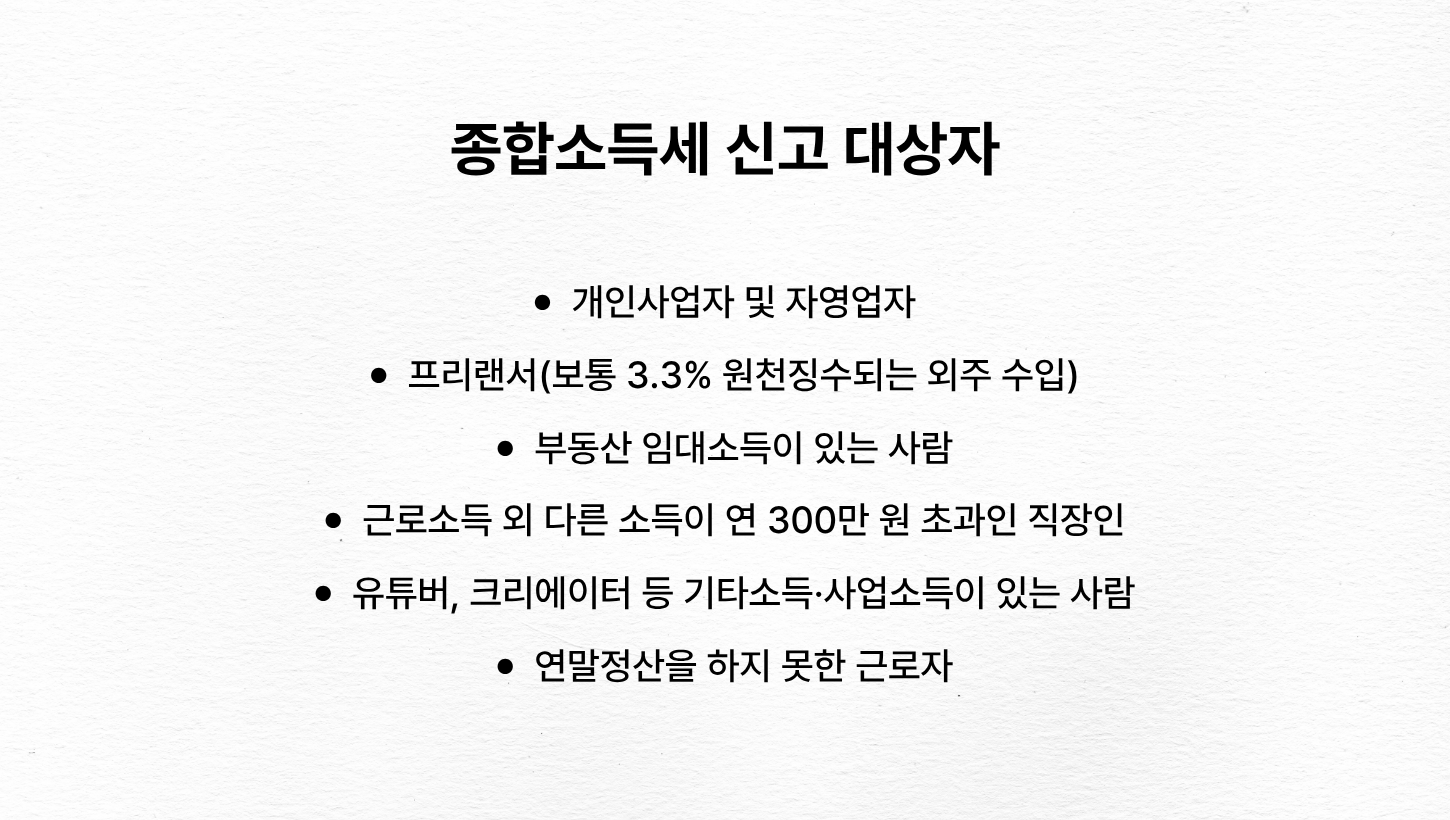
✅ 4️⃣ Who must file comprehensive income tax?
A. If any one of the below applies, you must file.
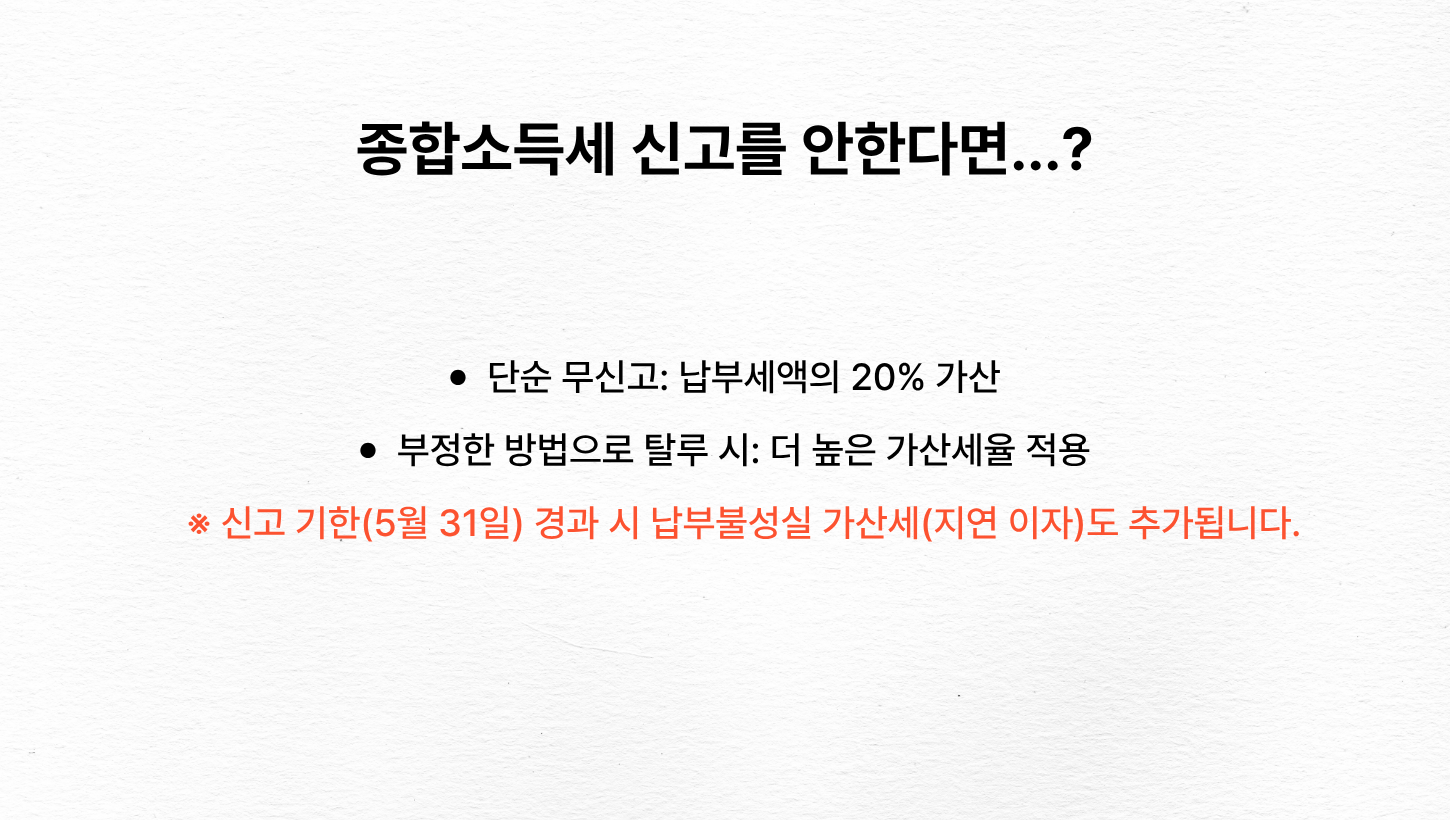
✅ 6️⃣ What happens if you don't file?
A. A "non-filing penalty" is imposed.
✅ A local income tax (Wetax) filing is also required separately.
Many people pay only the national tax (comprehensive income tax) and forget local income tax, so be sure to check both.
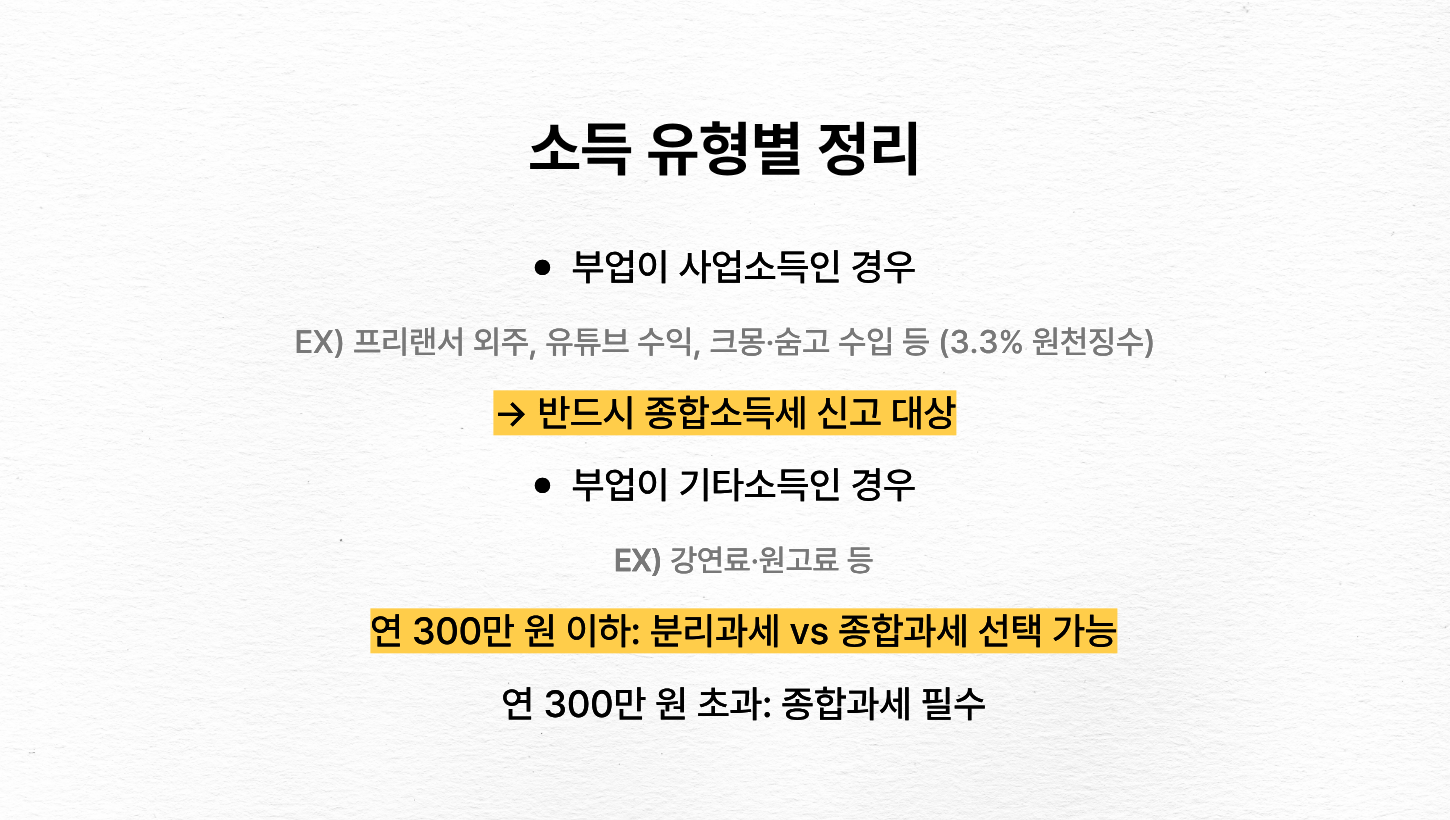
✅ 7️⃣ How do multi-income earners (employee + side job) file?
A. You must file comprehensive income tax in May, summing all your income.
Principle: sum all employment income + side-job income (business/other/employment)
Even if your company did year-end settlement in February, if you have side-job income you must file comprehensive income tax again in May.
📌 This article is based on tax law as of 2025.
Before you actually file, always confirm with Hometax / National Tax Service guidance and a tax professional.
