Virtual Office vs. Shared Office vs. Home Address — Comparing 3 Business Address Options
Virtual office, shared office, home address — we compare the cost, pros and cons, and ideal users for these 3 business address options.

To start a business, there's a problem you have to solve first of all: the business registration address.
A business registration address is the physical location of the place of business you enter when applying for business registration at the tax office. This address directly affects tax invoice issuance, mail receipt, and which tax office has jurisdiction.
There are broadly three options: virtual office, shared office, and home address. Costs range from 0 won a month to over 1,000,000 won, and each suits a completely different person. In this article, we lay out the cost, pros and cons, and recommended audience for each of the three options, with concrete numbers.
Why does a business registration address matter?
The address on a business registration certificate isn't merely information on paper. It's a key factor that directly affects external credibility, tax jurisdiction, and the screening for government support programs.
First, it affects external credibility. When a client or customer checks your business registration certificate and the address is an apartment, they may question your professionalism. Especially in B2B transactions or bidding processes, the business address becomes an indirect indicator of company scale.
Second, tax jurisdiction changes. The tax office with jurisdiction is determined by the business address, and the region where you pay local taxes changes too. If you establish a corporation in the Seoul metropolitan overconcentration control zone (most of Seoul, parts of Incheon, parts of Gyeonggi), the registration license tax is levied at triple the rate.
Third, it can affect screening for government support programs. Support programs such as the Korea Technology Finance Corporation guarantee or startup packages sometimes conduct on-site inspections. If actual business-activity space can't be confirmed at that point, it can work against you in screening.

Who is a virtual office right for?
A virtual office is an office where the business owner doesn't physically reside, but is provided with services such as a business registration address and mail receipt. Because you don't use actual space, it's very cheap—around 30,000–50,000 won a month.
Cost structure
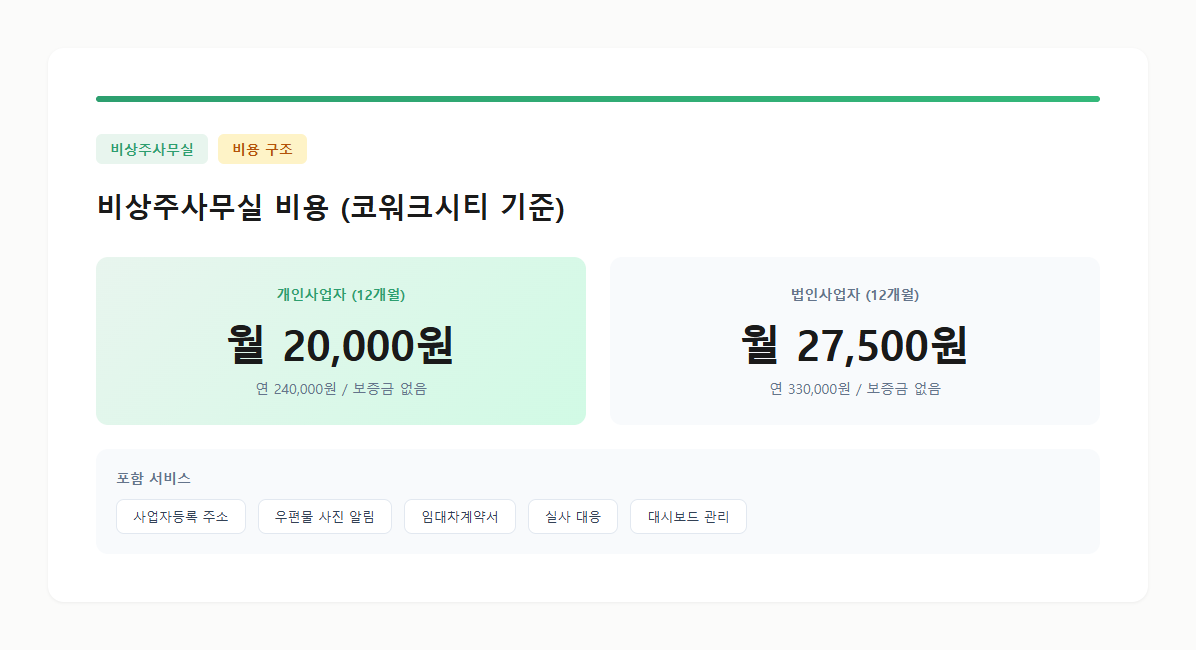
Based on CoworkCity, a sole proprietor pays 40,000 won a month (VAT included), or 240,000 won a year with a 12-month contract. Converted monthly, that's 20,000 won a month. A corporation pays 55,000 won a month, or 396,000 won a year (33,000 won a month). There's no deposit.
Included services
| Service | Details |
|---|---|
| Business registration address | Provides the address to enter on your business registration certificate |
| Mail management | Photo on arrival + KakaoTalk alert |
| Lease agreement | Issues the contract needed for the business registration application |
| Inspection response | Support for responding to a tax office on-site check |
| Dashboard | Online management of contract, billing, and mail |
Recommended for
- Online sellers on Smart Store, Coupang, etc. (no need for office space)
- Solo media operators such as freelancers and YouTubers
- Those who want to register a business without exposing their home address
- Those who need to file a mail-order business report
- Those who need to avoid the overconcentration control zone when setting up a corporation
⚠️ It can't be used for every business type. Businesses that need an actual place of business—manufacturing, restaurants, etc.—are hard to register with a virtual office, and some financial institutions may evaluate a virtual address conservatively.
Who is a shared office right for?
A shared office is a form of office where multiple companies divide and share a single workspace. Unlike a virtual office, it provides actual space you can commute to, with shared amenities like meeting rooms, lounges, and printers.
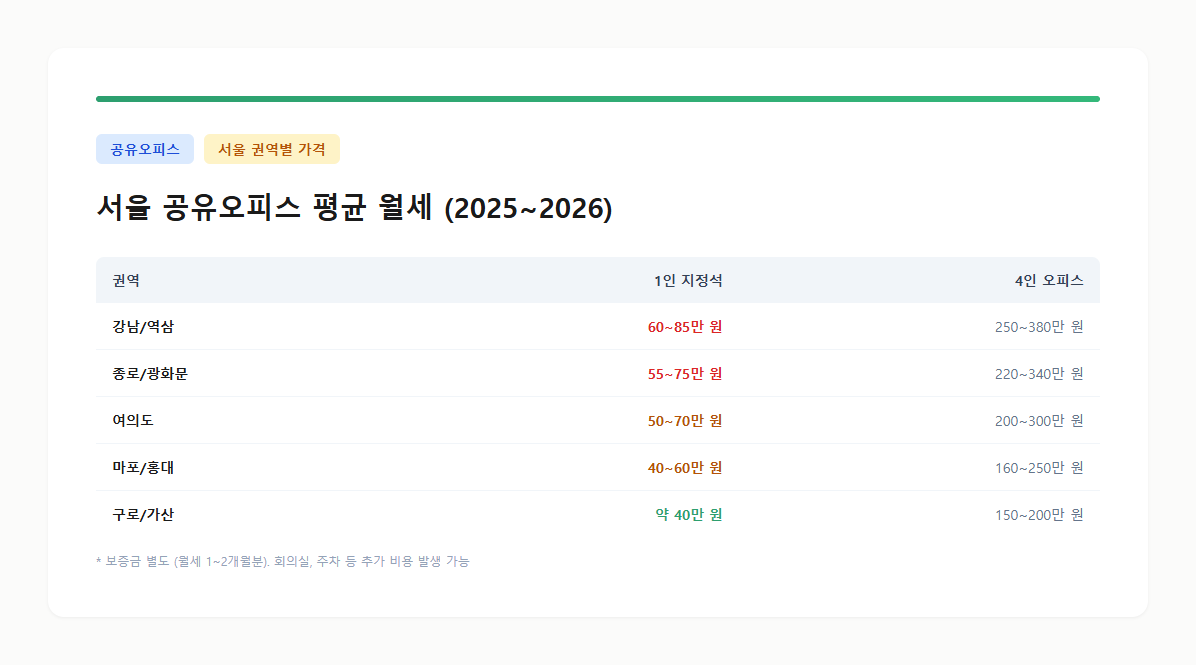
Average monthly rent by Seoul district (2025–2026)
A dedicated single seat in Gangnam/Yeoksam runs 600,000–850,000 won a month, Mapo/Hongdae 400,000–600,000 won a month, and Guro/Gasan around the 400,000-won range. On top of this, a deposit (1–2 months' rent) is added, and extra costs can arise for over-limit meeting-room use, parking, after-hours heating/cooling, and so on.
| District | Dedicated single seat (monthly) | 4-person office (monthly) |
|---|---|---|
| Gangnam/Yeoksam | 600,000–850,000 won | 2.5M–3.8M won |
| Jongno/Gwanghwamun | 550,000–750,000 won | 2.2M–3.4M won |
| Yeouido | 500,000–700,000 won | 2M–3M won |
| Mapo/Hongdae | 400,000–600,000 won | 1.6M–2.5M won |
| Guro/Gasan | around the 400,000-won range | 1.5M–2M won |
Recommended for
- Teams of two or more who need actual workspace
- Business types with frequent in-person meetings (consulting, design agencies, etc.)
- Startups preparing to raise investment, for whom having a tangible place of business matters
⚠️ A shared-office single seat (400,000–850,000 won a month) is 10–20 times a virtual office (20,000–50,000 won a month). For a solo proprietor who doesn't really need workspace, it can be an excessive cost.
Who is a home address right for?
Registering a business with your home address costs 0 won. You can register your current residence as your place of business with no separate contract or documents.
But a home address has downsides that are hard to ignore.
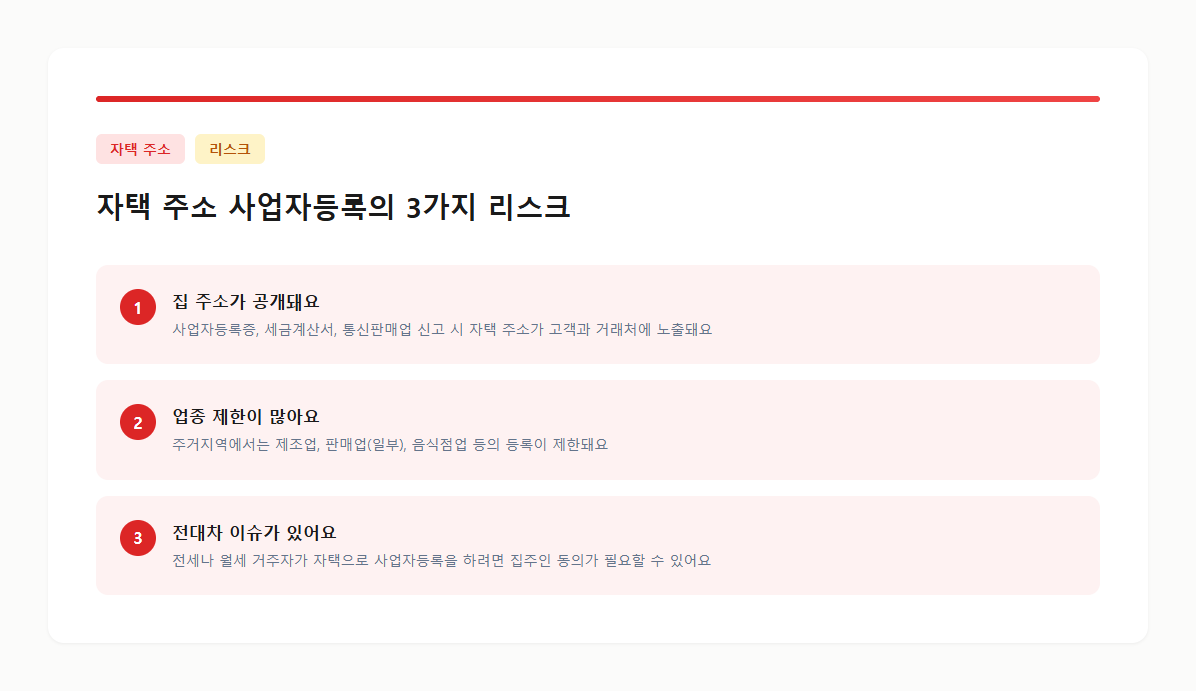
First, your home address becomes public. On the business registration certificate, tax invoices, and mail-order business report, your home address is exposed to customers and clients. The address is also viewable through the National Tax Service's business lookup service.
Second, there are many business-type restrictions. In residential areas, business registration is restricted for manufacturing, sales (some), restaurants, and the like. For apartments, business registration itself may be difficult depending on the management bylaws.
Third, there are sublease issues. A sublease (轉貸借) is a contract in which the original tenant re-leases to a third party. If a renter (jeonse/monthly) wants to register a business at their home, the landlord's consent may be required.
ℹ️ A home address is an option in the very earliest stage of testing a business idea, when address exposure isn't a major concern, or when you can't spend a single won.
The 3 options at a glance
The table below compares the key differences among virtual office, shared office, and home address by item.
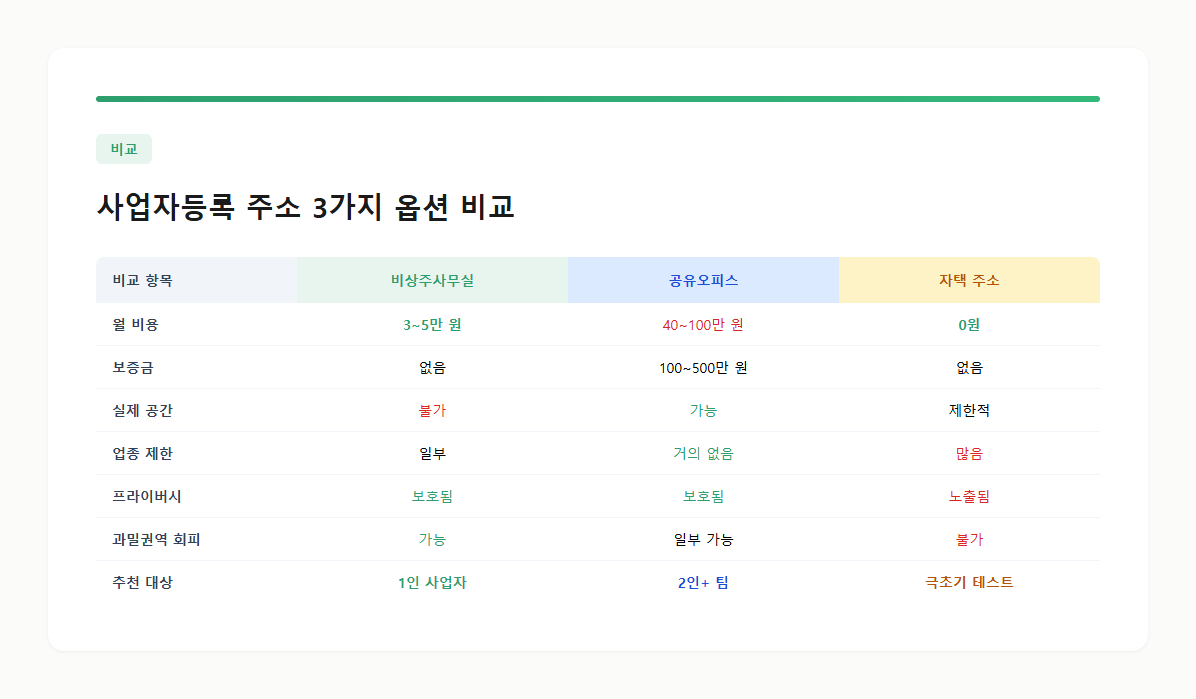
The cost difference is the starkest. A virtual office (30,000–50,000 won a month) and a shared office (400,000–1,000,000 won a month) differ by 10–20 times. If you don't need actual workspace, a virtual office is overwhelmingly more efficient.
What's the right choice for my situation?
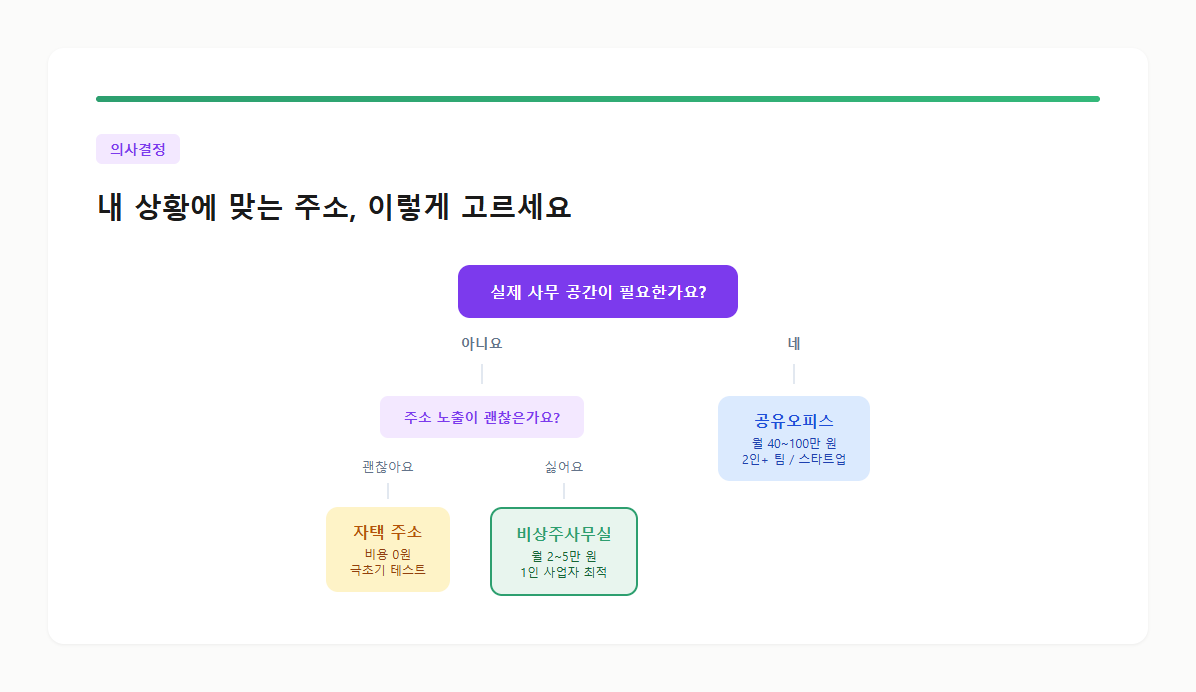
The decision is simpler than you'd think. It narrows down to a single question: "Do I need actual workspace?"
If you don't need workspace → virtual office. It's the most sensible for solo proprietors, freelancers, and online sellers working alone. CoworkCity is available from the 20,000-won-a-month range (on a 12-month basis) at 160 branches nationwide. Online contracting is possible 24/7, and if your business registration is rejected, a 100% refund is guaranteed.
If you need workspace → shared office. If your team has two or more members or you have frequent in-person meetings, a shared office is the fit. Just confirm first whether you can sustain the fixed cost of 400,000 won or more a month.
If it's a very early test → home address. In the stage of quickly validating a business idea, home is also an option. But once revenue starts coming in, we recommend switching to a virtual office for privacy and credibility.
CoworkCity is a platform where you can contract and manage virtual offices at 160 branches nationwide online. You can sign an address contract even before business registration, and handle photo alerts for mail and dashboard management all in one place.
Find an office near my place of business at CoworkCity
Frequently asked questions (FAQ)
Related articles
Worried about virtual office rejection? A must-check checklist
Everything about virtual offices, told by an insider
A complete guide to government support programs for those preparing to start a business in 2026
Written by the CoworkCity content team
Why freelancers need a virtual office (coming soon)
Frequently Asked Questions
비상주사무실에서 공유오피스로 전환할 수 있나요?
네, 가능해요. 비상주사무실 계약을 해지하고 공유오피스로 새로 계약하면 돼요. 이때 세무서에 사업장 이전 신고(정정 신고)를 해야 해요. 관할 세무서가 바뀌면 부가세 신고 기한 등에 영향이 있을 수 있으니, 전환 시점은 부가세 신고 기간 이후로 맞추는 것이 좋아요. 홈택스에서 온라인으로 정정 신고가 가능해요.
자택 주소에서 비상주사무실로 바꾸면 비용이 드나요?
주소 변경 자체는 홈택스에서 무료로 할 수 있어요. 다만 비상주사무실 이용료가 새로 발생해요. 코워크시티의 경우 개인사업자 기준 월 결제 시 월 40,000원, 12개월 계약 시 연 240,000원(월 20,000원)이에요. 보증금은 없고, 사업자등록 정정 신고는 홈택스에서 바로 처리할 수 있어요.
공유오피스와 비상주사무실을 동시에 이용하는 경우도 있나요?
네, 있어요. 대표적인 사례가 본사 주소는 과밀억제권역 밖 비상주사무실에 두고, 실제 업무는 강남 공유오피스에서 하는 법인이에요. 이렇게 하면 법인 설립 시 등록면허세 3배 중과를 피하면서 실제 업무 공간은 확보할 수 있어요. 특히 IT·스타트업 업종에서 많이 활용하는 전략이에요.
투자자들이 비상주사무실 주소를 부정적으로 보나요?
초기 스타트업의 경우 비상주사무실 주소를 부정적으로 보는 투자자는 드물어요. 시드·프리시리즈 단계에서는 제품과 팀이 더 중요한 평가 요소예요. 다만 시리즈A 이후 단계에서는 실제 사무 공간이 있는 것이 조직 안정성과 신뢰도 측면에서 유리할 수 있어요.
비상주사무실 주소로 택배 수령이 가능한가요?
대부분의 비상주사무실은 일반 우편물(등기, 일반 서신, 관공서 서류)을 수취해요. 택배 수령은 업체마다 정책이 달라요. 코워크시티는 우편물 도착 시 사진을 찍어 카카오톡으로 알려주고, 수령·전달·폐기를 선택할 수 있어요. 대형 택배는 사전 문의가 필요할 수 있어요.
