Are There Industry Restrictions When Registering a Business at a Virtual Office Address?
We've laid out which industries can and can't register at a virtual office address. Building-register use, e-commerce business filing, restrictions on food, medical, and manufacturing — just the essentials.


When looking into business registration with a virtual office, the first question that comes to mind is "Will my business type qualify too?" To get straight to the point, almost any office-based business can be registered, while businesses requiring a physical storefront or a license are difficult. The two key criteria for judging this are the nature of your business type and the building-register use of the virtual office building.
Which business types can be registered with a virtual office?
The business types eligible for business registration at a virtual office address are office-based businesses. If your business doesn't require a physical store, manufacturing equipment, a storage warehouse, or in-person customer service, a business registration certificate will be issued normally even with a virtual office address. The key criterion the tax office looks at is "whether this is a line of business that can actually be conducted at this address."

- E-commerce and mail-order sales (smart stores, own-brand malls, Coupang sellers)
- IT/SW development (web/app development, SaaS, data analytics)
- Consulting and professional services (management consulting, tax/labor advisory, coaching, instructing)
- Marketing and advertising agencies (performance marketing, SNS account management)
- Design and creative work (graphic design, video editing, illustration, photography)
- Translation/interpretation, online education, trade
ℹ️ Among CoworkCity virtual office subscribers, the TOP 5 most registered business types are ① e-commerce (mail-order sales) ② IT/SW development ③ marketing and advertising agencies ④ consulting and education ⑤ design and content production. Over roughly 80% of solo proprietors and freelancers fall into business types in these categories.
Which business types are difficult to register with a virtual office?
The business types difficult to register at a virtual office address are those for which a physical site is legally mandatory. Such businesses undergo facility inspections at a separate licensing stage, not just tax-office acceptance, so the very structure of a virtual office—borrowing only an address to register—doesn't hold up. Without physical facilities, the license itself is rejected.
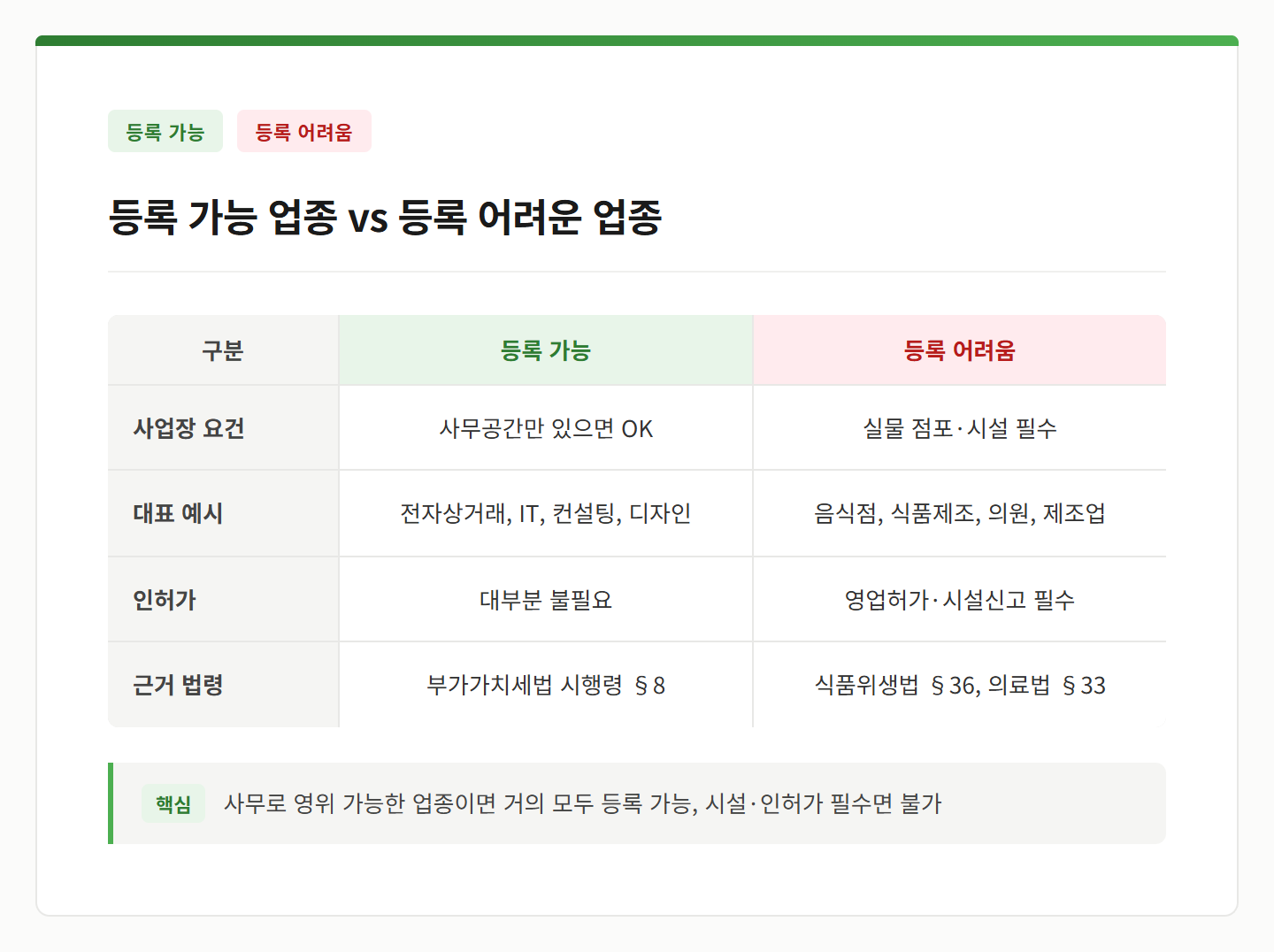
Restaurants and food manufacturing can only file a business report after meeting physical requirements such as a kitchen, washing area, and ventilation, per Article 36 of the Food Sanitation Act and the "facility standards by business type" in Annex 14 of its enforcement rules. Medical institutions can only file an establishment report with the city/provincial governor after meeting facility standards such as examination rooms, waiting rooms, and medical equipment, per Article 33 of the Medical Service Act. Manufacturing and warehousing are separately subject to factory registration, hazardous-materials safety management, and industrial-complex occupancy requirements. Such businesses fundamentally cannot proceed with a virtual office address.
Why do building-register use and business type matter?
Building-register use is the single biggest cause of rejection for virtual office registration. When you apply for business registration, the tax office always checks the building register for the lease agreement's address, and if the building's legal use doesn't match the applied-for business type, the application itself is rejected. Even within the same building, eligibility can differ by unit, and this difference is determined by the use classification in Annex 1 of the Building Act Enforcement Decree.

Among cases of virtual office business-registration rejection, unsuitable building use is reported to account for the largest share. It's especially common to be rejected after signing for a residential officetel (a building reported as housing), mistaking it for an office. CoworkCity operates all branches only as business facilities or neighborhood living facilities, so the risk of rejection due to a building-register use problem is structurally eliminated.
ℹ️ Related article: Worried about virtual office rejection? A must-check checklist — we've compiled the reasons for rejection and how to check in advance.
Which business types, such as mail-order sales, require additional reporting?
Mail-order sales can complete both business registration and a mail-order business report at a virtual office address. Online-transaction businesses such as smart stores, Coupang, and own-brand malls must, separately from VAT-Act business registration, file a mail-order business report with the city/county/district office that has jurisdiction, per the E-Commerce Act. The report can be filed 100% online at Gov24 (www.gov.kr), and the result is notified by text within 2–3 business days of applying.
⚠️ When filing, simply enter the virtual office address as the place of business, and it must exactly match the address on the lease agreement to avoid rejection.
Other business types possible at a virtual office address with additional reporting
- Publishing — possible with just business registration, no separate report
- Trade (import/export) — instant online issuance of a Korea International Trade Association trade business ID
- Interior and indoor-construction work — possible only for small-amount licenses (under 30 million won)
- Real estate brokerage — but with on-site inspection of the office, it's effectively difficult with a virtual office
On what basis should you choose a virtual office?
The two most important criteria when registering a business with a virtual office are: (1) whether your business type is office-based, and (2) whether the virtual office's building-register use is business facility/neighborhood living facility. As long as these two criteria are met, virtually all office-based business types—solo founders, freelancers, online sellers, IT developers, consultants, and so on—can be issued a business registration certificate normally.

CoworkCity operates all branches only as business facilities or neighborhood living facilities, so if your type falls within the eligible business types, you can proceed with business registration without rejection risk. For business types requiring additional reporting, such as mail-order sales and trade, the lease agreement's address is used as is, so the process proceeds without separate administrative steps.
✅ To summarize so far
- Office-based business types (e-commerce, IT, consulting, design, etc.) can be registered with a virtual office.
- Business types requiring facilities or licensing—restaurants, food manufacturing, medical institutions, manufacturing—are not possible.
- The key criterion is building-register use — it must be "business facility" or "neighborhood living facility."
- Mail-order sales are processed within 2–3 business days when filed at Gov24.
- All CoworkCity branches are operated as business facilities/neighborhood living facilities, so rejection risk is eliminated.
Wrapping up
Virtual office business registration is simpler than you'd think. You only need to check two things: whether your business type is office-based, and whether the building use is suitable. CoworkCity operates only branches that meet both conditions, so if you have an office-based business, you can proceed with business registration without worrying about rejection. Additional reporting, such as for mail-order sales and trade, can also be done with the same address as is.
Browse CoworkCity virtual offices
Recommended reads
Frequently Asked Questions
스마트스토어나 쿠팡 셀러도 비상주사무실로 사업자등록이 가능한가요?
네, 가능해요. 전자상거래·통신판매업은 사무 기반 업종으로 분류되어 비상주사무실 주소로 사업자등록이 정상적으로 이뤄져요. 사업자등록 후 정부24에서 통신판매업 신고를 별도로 진행하면 되고, 영업일 기준 2~3일 안에 신고증이 발급돼요. 임대차계약서상 주소를 그대로 기재해야 반려가 없어요.
유튜버·크리에이터도 비상주사무실로 사업자등록이 가능한가요?
네, 가능해요. 1인 미디어 콘텐츠 창작업(업종코드 921505)은 대표적인 사무 기반 업종이에요. 촬영 스튜디오가 별도로 필요하더라도 사업장 주소는 비상주사무실로 등록할 수 있고, 광고 수익·협찬 매출은 비상주사무실 주소로 정상 신고돼요. 별도 인허가는 필요하지 않아요.
수출입 무역업도 비상주사무실로 등록 가능한가요?
네, 무역업은 비상주사무실로 등록 가능해요. 사업자등록 후 한국무역협회에서 무역업 고유번호를 온라인으로 신청하면 즉시 발급돼요. 단, 실제 물품 보관·창고가 필요한 경우에는 별도의 보관 장소(3PL, 풀필먼트)를 활용하고, 행정 주소만 비상주사무실로 운영하는 구조가 일반적이에요.
부동산 중개업도 비상주사무실로 등록 가능한가요?
부동산 중개업은 사실상 어려워요. 공인중개사법에 따라 개설등록 시 사무소 실사가 진행되고, 독립된 출입구·간판·고객 응대 공간 요건을 충족해야 해요. 비상주사무실은 실사 요건을 통과하기 어렵기 때문에, 부동산 중개업은 반드시 상주가 가능한 사무실을 별도로 마련해야 해요.
학원·교습소도 비상주사무실로 등록 가능한가요?
학원·교습소는 어려워요. 학원의 설립·운영 및 과외교습에 관한 법률에 따라 강의실·면적·소방시설 등 시설기준을 충족해야 교육청에서 등록증이 발급돼요. 다만 비대면(온라인) 교육 서비스업은 시설기준이 적용되지 않아 비상주사무실로 사업자등록이 가능해요.
