Virtual Office Business Registration: 5 Reasons It Gets Rejected and How to Handle Them
The 5 reasons virtual office business registrations get rejected (building use, industry restrictions, incomplete contracts, failure to handle inspections, suspicion of being a paper company) and how to address each.

Key summary (TL;DR)
- Per related reporting, about 12,000 business registrations were rejected over business-address issues in 2024. Most rejections aren't problems with virtual offices themselves but stem from incomplete documents or procedures.
- The five main reasons for rejection are mismatched building use, business-type restriction violations, an inadequate lease agreement, failure to respond to inspections, and suspicion of being a "paper-invoice" operator.
- You must check the building register to confirm the building use is "neighborhood living facility" or "business facility."
- In-person/facility-mandatory businesses such as manufacturing and restaurants cannot be registered with a virtual office, or require additional justification.
- CoworkCity offers a pre-contract review of business-type suitability and guarantees a 100% refund in the event of rejection.
When preparing to register a business with a virtual office, the worry "what if it gets rejected?" is bound to arise. A virtual office is an office where the business owner doesn't physically reside, but is provided with services such as a business registration address and mail receipt.
To get straight to the point, rejection is mostly not a problem with virtual offices themselves but occurs at the stage of document preparation and business-type verification. This article lays out the 5 reasons rejection actually occurs and how to handle each.
Virtual office business-registration rejection — how common is it?
Per related reporting, business registration applications rejected over the course of 2024 on the grounds that "the business address differs from the actual place of business" numbered about 12,000. This figure is roughly 1.5% of all business registration applications, meaning most applications are processed normally.
The important point is that most rejection reasons are not problems with virtual offices themselves but incomplete documents or unsuitable business types. The main causes are not checking the building use, missing required items in the lease agreement, or choosing a business type that's hard to register.
Put another way, checking just 5 checkpoints in advance can greatly reduce rejection risk.
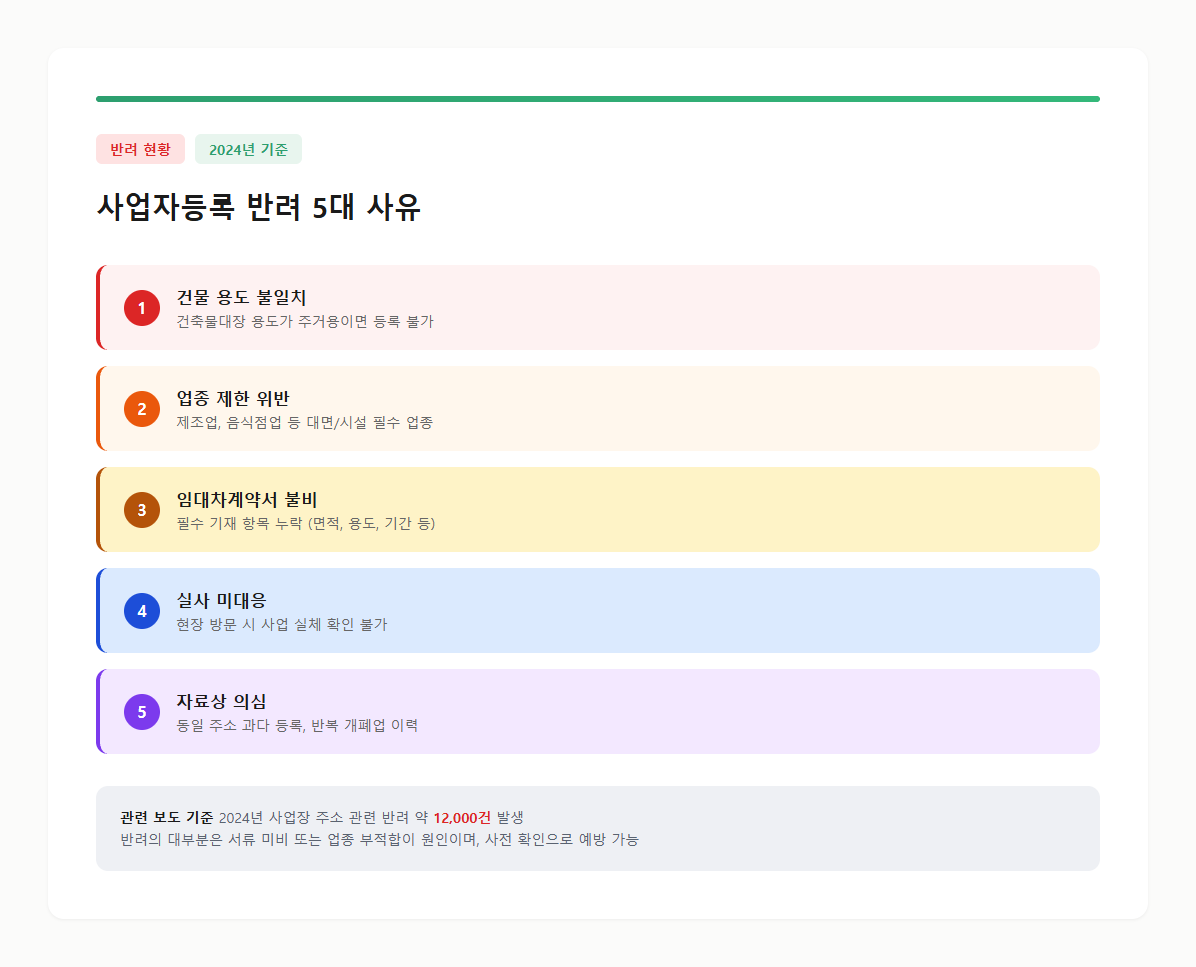
Rejection reason ① — What happens if the building use is mismatched?
If the building use listed on the building register is "residential (apartment, single-family home, etc.)," business registration may be rejected. The tax office checks the building register for the place of business to determine whether the building can be used for business purposes.
Building uses eligible for business registration are as follows.
- Neighborhood living facility: a use that includes offices, shops, academies, etc.—the use under which the most business types can be registered
- Business facility: a building constructed for business purposes, such as an office building
- Sales facility: a facility related to wholesale/retail
How to handle it: You can view the building register free of charge at Gov24 (gov.kr). Before signing a virtual office contract, be sure to verify that the building's use is "neighborhood living facility" or "business facility." All 160 CoworkCity branches nationwide are located in buildings with uses eligible for business registration.
Rejection reason ② — Are there business types that can't be registered?
Not every business type can be registered at a virtual office. Business types that require physical facilities or in-person service cannot be registered with a virtual office, or require additional justifying documents.
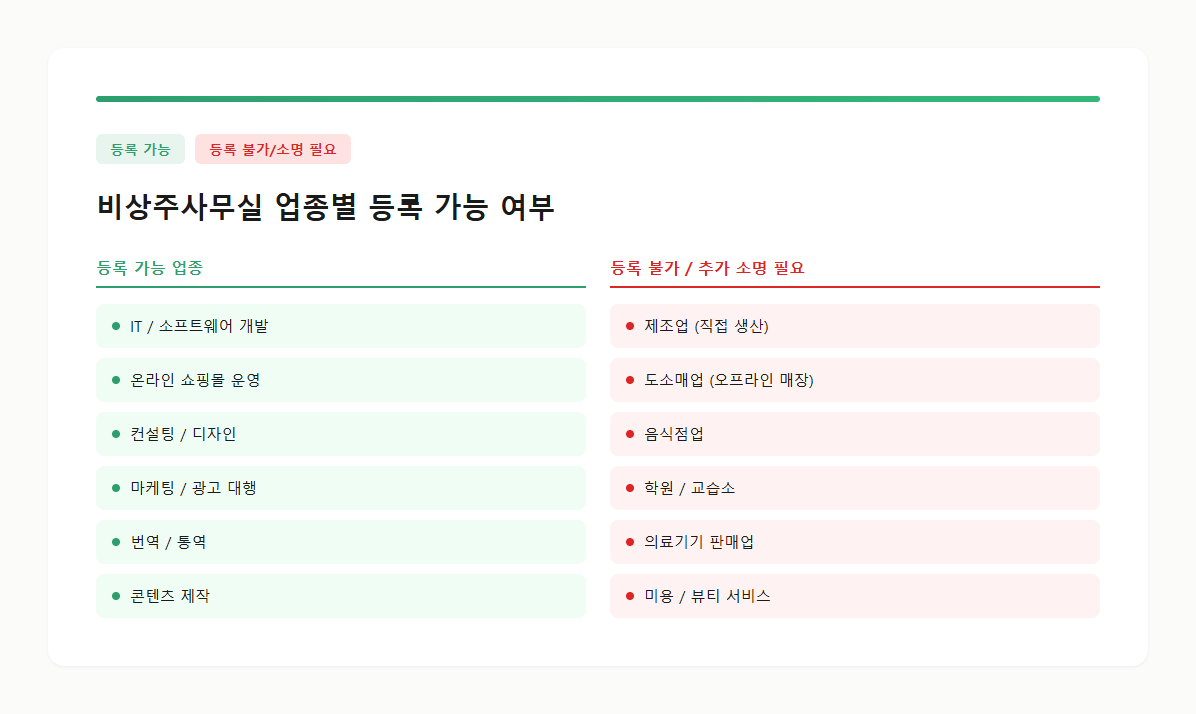
✅ Eligible business types: IT/software development, online shopping mall operation, consulting/design, marketing/advertising agency, translation/interpretation, content production
⚠️ Not eligible or requiring additional justification: manufacturing (direct production), wholesale/retail (offline store), restaurants, academies/tutoring centers, medical-device sales, beauty services
Looking at CoworkCity's actual registration data, the most registered business types are as follows.
- No. 1: Wholesale and retail — e-commerce, overseas-purchase agency, mail-order sales, etc. (about 55–60%)
- No. 2: Professional, scientific, and technical services — consulting, advertising agency, design, etc. (about 12–15%)
- No. 3: Information and communications — software development, content production, video production, etc. (about 8–10%)
- No. 4: Construction — plumbing/HVAC work, indoor construction, electrical/telecom work, etc. (about 6–8%)
- No. 5: Business-facility management, business support, and rental services (about 6–7%)
More than half of all registrations are wholesale and retail. Within that, e-commerce retail is the most common, with sellers on online platforms such as Naver Smart Store, Coupang, and Amazon making up the majority.
How to handle it: Even if manufacturing is among your business types, registration may be possible if you can attach documents (a supply contract, a contract-manufacturing agreement, etc.) proving a "structure of receiving supply from a manufacturer rather than producing directly." Wholesale/retail is also registrable if it's mainly online sales. That said, judgment standards can differ by the tax office with jurisdiction, so it's important to verify business-type suitability before signing.
CoworkCity offers a pre-contract business-type suitability review service. You can be advised in advance whether the business type you want to register is suitable for a virtual office and whether additional justifying documents are needed.
Rejection reason ③ — What happens if the lease agreement is incomplete?
If required items are missing from the lease agreement, the tax office may request supplementation or reject the application. The lease agreement submitted for business registration must include the following 5 required items.
- Landlord information: name, resident registration number (or business registration number), contact
- Location: the exact building address (including building and unit numbers)
- Leased area: the exclusive-use area stated (for a virtual office, 1.1㎡ or more)
- Contract period: start and end dates specified
- Use: clearly stated as "office" or "for business use"
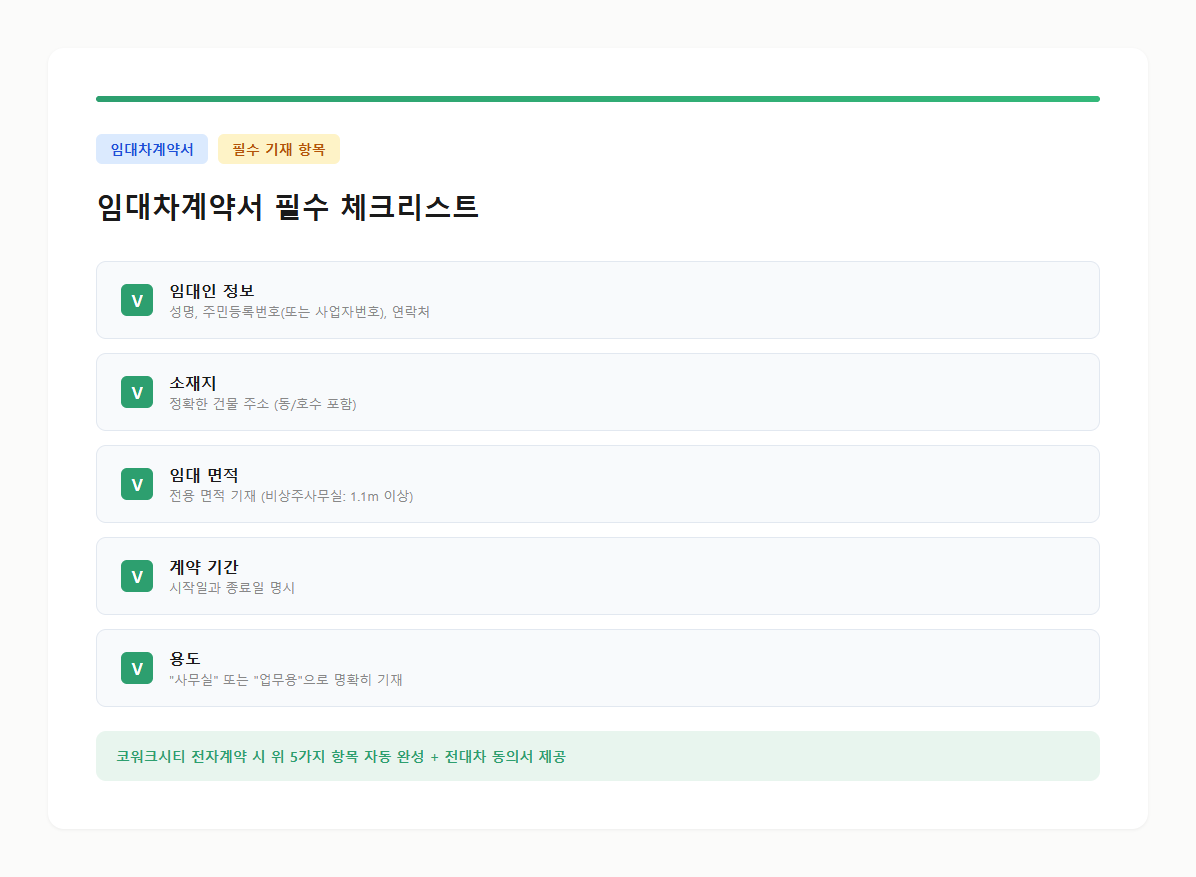
How to handle it: In CoworkCity's electronic contract system, the 5 items above are auto-completed and filled in without omission. A sublease (subletting is when the original tenant re-leases to a third party) consent form is also provided, so the risk of rejection due to incomplete documents is nearly nonexistent.
Rejection reason ④ — What happens if you can't respond to a tax office on-site inspection?
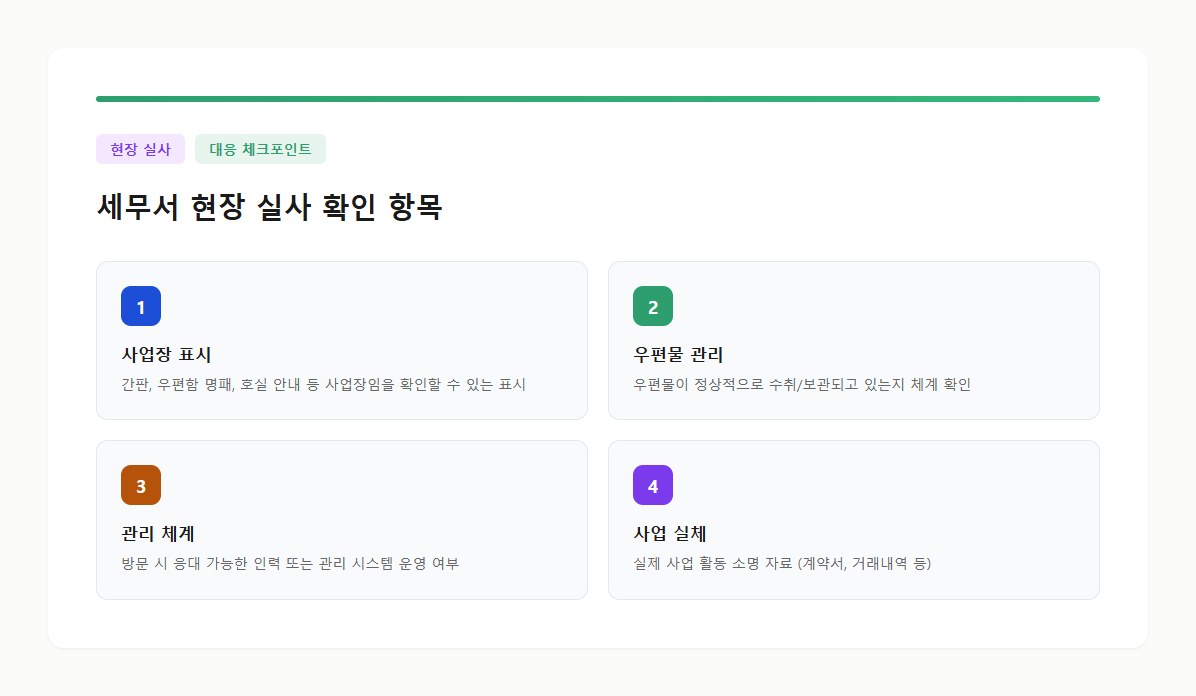
The tax office may conduct an on-site inspection of the place of business after a business registration application if it deems it necessary. Inspections aren't conducted for every application but are carried out selectively, considering factors like business-type characteristics and the address's history.
The main items checked in an on-site inspection are as follows.
- Business signage: signs, mailbox nameplates, unit guides, and other markings confirming it's a place of business
- Mail management system: whether mail is being properly received and stored
- On-site staff or management system: staff or a management system available to respond on a visit
- Confirmation of business substance: justifying documents on whether actual business activity is taking place
Documents to prepare for an inspection:
- Lease agreement (PDF or printout)
- Sublease consent confirmation
- Business-related materials (business plan, quotes, transaction records, etc.)
Precautions when responding to an inspection: It's best to reply to the tax office's contact the same day. The business type registered on Hometax must match your actual work, and you should avoid phrases like "I just registered the address" or "I only work from home." Instead, it's better to explain "I use it as a base for running my business" or "it's my official place of business and work base."
CoworkCity inspection-response support: CoworkCity provides mailbox nameplate installation and mail receipt/storage/alert services as standard at 160 branches nationwide. If an inspection is needed, we provide an inspection-response guide that includes answer strategies for anticipated questions and a list of what to prepare.
Rejection reason ⑤ — What happens if you're suspected of being a "paper-invoice" operator?
A paper-invoice operator is a business that receives payment by issuing tax invoices without actual transactions. The tax office strengthens paper-invoice suspicion screening for addresses where many businesses are registered at the same address, or which have a history of repeated openings and closures over a short period.
The main patterns drawing paper-invoice suspicion are as follows.
- An excessive number of businesses registered at the same address
- A history of paper-invoice operators being caught at that address
- The applicant's business type being one highly associated with paper-invoice operators (precious metals, steel, petroleum products, etc.)
- Insufficient materials to justify the business's substance
How to handle it: When choosing a virtual office, it's important to pick a place where the management of occupant businesses at that address is systematic. CoworkCity screens occupant businesses to block the entry of illegal operators such as paper-invoice operators in advance. In addition, some branches limit a single business from filing multiple business registrations at the same address, and you can check whether this applies in advance under "Operating Info — Notes" on each branch's detail page.
How do you reapply if you're rejected?
Even if your business registration is rejected, there's no separate legal fine or sanction for the rejection itself, and you can reapply anytime after supplementing the reason for rejection.
The 3 steps to reapply
- Confirm the reason for rejection: accurately confirm the rejection reason the tax office notifies you of. You can also check it under Hometax's "business registration civil-application processing status lookup."
- Prepare supplementary documents: supplement the documents corresponding to the rejection reason. A building-use problem requires changing to a suitable address; a business-type problem requires preparing justifying documents; a contract problem requires supplementing the missing items.
- Reapply: reapply to the tax office with the supplementary documents in hand. Processing on reapplication usually takes 2–5 business days.
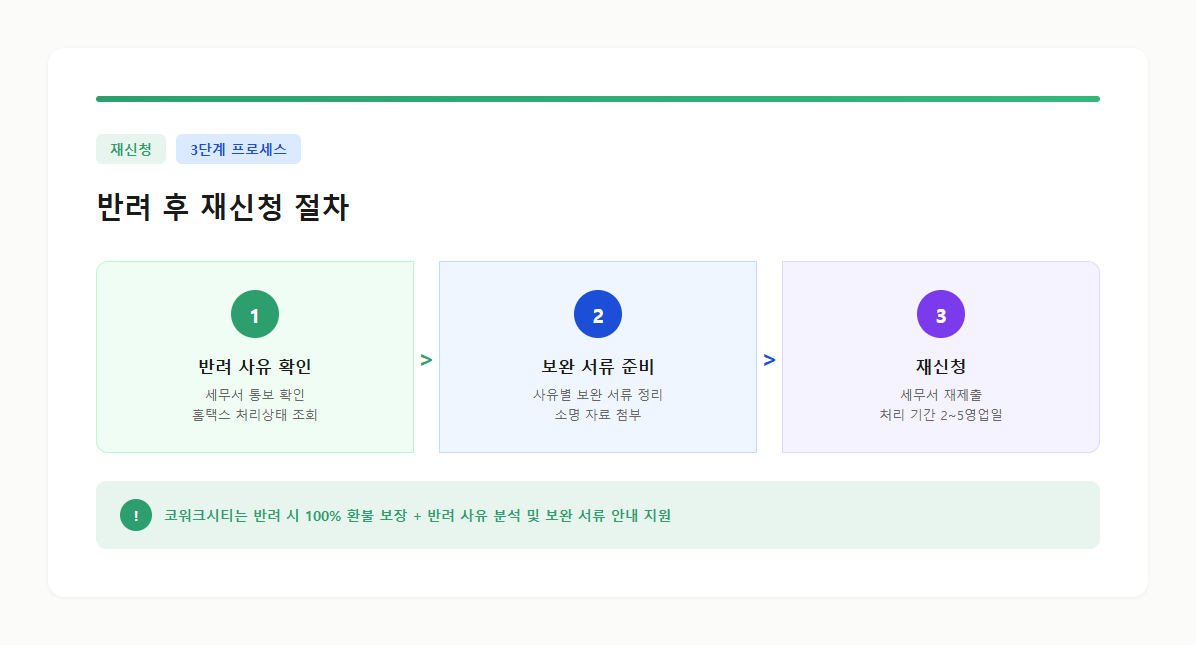
CoworkCity rejection support policy: If your business registration is rejected after signing with CoworkCity, we guarantee a 100% refund. We also support rejection-reason analysis and supplementary-document guidance to raise your reapplication success rate.
On what basis should you prevent business-registration rejection?
Over 90% of business-registration rejections can be prevented with advance verification. The two most important checkpoints are verifying the building use and reviewing business-type suitability.
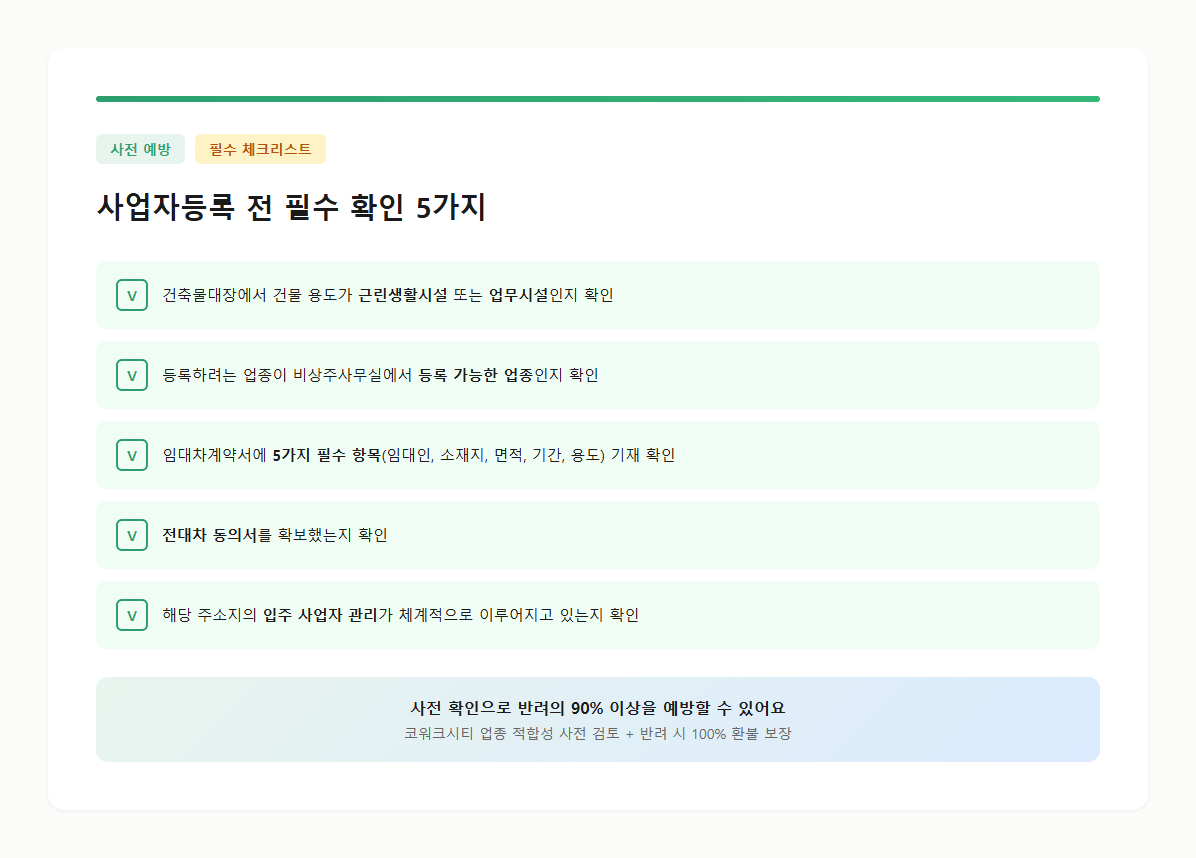
If you're preparing to register a business with a virtual office, get a pre-contract business-type suitability review from CoworkCity. You can check your rejection risk before signing and, even if you're rejected, be guaranteed a 100% refund.
Check whether my business type can be registered
Find a virtual office near you
Frequently asked questions (FAQ)
Related articles
How to register a business with a virtual office: a complete 5-step guide
Worried about virtual office rejection? A must-check checklist
Frequently Asked Questions
사업자등록이 반려되면 페널티가 있나요?
반려에 대한 별도의 과태료나 법적 제재는 없어요. 횟수 제한도 없으며, 사유를 보완하면 언제든 재신청할 수 있어요. 다만 반복 반려 시 세무서 심사가 까다로워질 수 있으므로 처음부터 서류를 꼼꼼히 준비하는 것이 좋아요.
세무서마다 반려 기준이 다른가요?
네, 관할 세무서와 담당 주무관에 따라 기준이 달라질 수 있어요. 같은 업종이라도 바로 승인되기도 하고 추가 소명을 요구하기도 해요. 코워크시티처럼 세무서별 특성을 파악하고 있는 업체를 이용하면 유리해요.
통신판매업은 비상주사무실로 등록할 수 있나요?
통신판매업은 비상주사무실에서 등록이 가능한 대표적인 업종이에요. 사업자등록 후 관할 구청에 통신판매업 신고를 별도로 진행하면 돼요. 온라인 쇼핑몰, 스마트스토어, 해외구매대행 등 대부분의 전자상거래 업종이 비상주사무실에서 등록 가능해요.
스마트스토어는 어떤 업종코드로 등록하나요?
스마트스토어는 일반적으로 업종코드 525101(전자상거래 소매업)로 등록해요. SNS를 통한 판매라면 525104(SNS마켓)를 사용해요. 취급 상품에 따라 적합한 코드가 달라질 수 있으므로, 사업자등록 전에 관할 세무서나 비상주사무실 업체에 확인하는 것이 좋아요.
쿠팡 입점 시 비상주사무실 주소로 문제없나요?
쿠팡(마켓플레이스)은 사업자등록증에 기재된 주소를 기준으로 입점 심사를 진행하므로, 비상주사무실 주소로도 입점이 가능해요. 다만 쿠팡 로켓그로스 등 일부 서비스는 실제 물류 주소를 별도로 요구할 수 있으니 입점 요건을 미리 확인하세요.
