Is Registering a Business at a Virtual Office Legal? The Latest 2026 Standards
Registering a business using a virtual office is a legal method grounded in the VAT Act. Based on the latest 2026 standards, we lay out the line between legal and risky, plus the 4 essential conditions.

Key Summary (TL;DR)
- Registering a business with a virtual office is legal, based on Article 6 of the VAT Act.
- The tax authority isn't cracking down on virtual offices themselves, but on tax evasion that uses a business premises with no substance.
- The 4 elements of legitimate use: a legitimate lease agreement, building use that matches, a mail/visitor response system, and genuine business substance.
- As the tax authority has recently stepped up on-site inspections of virtual offices, proving substance has become the key point.
- All 66 of CoworkCity's branches nationwide operate in buildings used as neighborhood living facilities or business facilities.
"Isn't registering a business with a virtual office illegal?"—that's the first worry people have when they start looking into virtual offices.
A virtual office is an office where a business owner receives services such as a business registration address and mail reception without actually being present there. It can be used for around 30,000–50,000 won per month, so it's popular with one-person founders and online businesses. Overseas, it has operated legally for decades under the name "Virtual Office."
But when you type "virtual office" into a search bar, words like "illegal," "rejection," and "tax audit" come up alongside it, so it's natural to feel anxious about whether it's a legitimate service. To get straight to the point: registering a business with a virtual office is a legitimate method grounded in the VAT Act.
That said, not all virtual offices come with the same conditions. In this post, we'll lay it all out by the latest 2026 standards—from the legal basis to why the tax authority cracks down, the line between legal and risky use, and the conditions for using one safely.
What is the legal basis for registering a business with a virtual office?
Registering a business with a virtual office is legal. Article 6(2) of the VAT Act defines a place of business as "a fixed place where a business owner conducts all or part of its transactions in order to do business." A virtual office falls under a legitimate type of place of business that meets this requirement.
The law does not require a business owner to commute to that location every day. It's enough to have a fixed place where "all or part" of the transactions are carried out. If it's a place where mail is sent and received, where the tax invoice address is, and where business-related communications are received, it can be recognized as a place of business.
Domestically, the government transition committee discussed measures to revitalize virtual-space startups back in 2022, and as of 2025, new business registrations in Korea reach roughly 1.5 million per year. As the proportion of one-person and online businesses among them keeps rising, demand for virtual offices is growing too.

Why does the tax authority keep an eye on virtual offices?
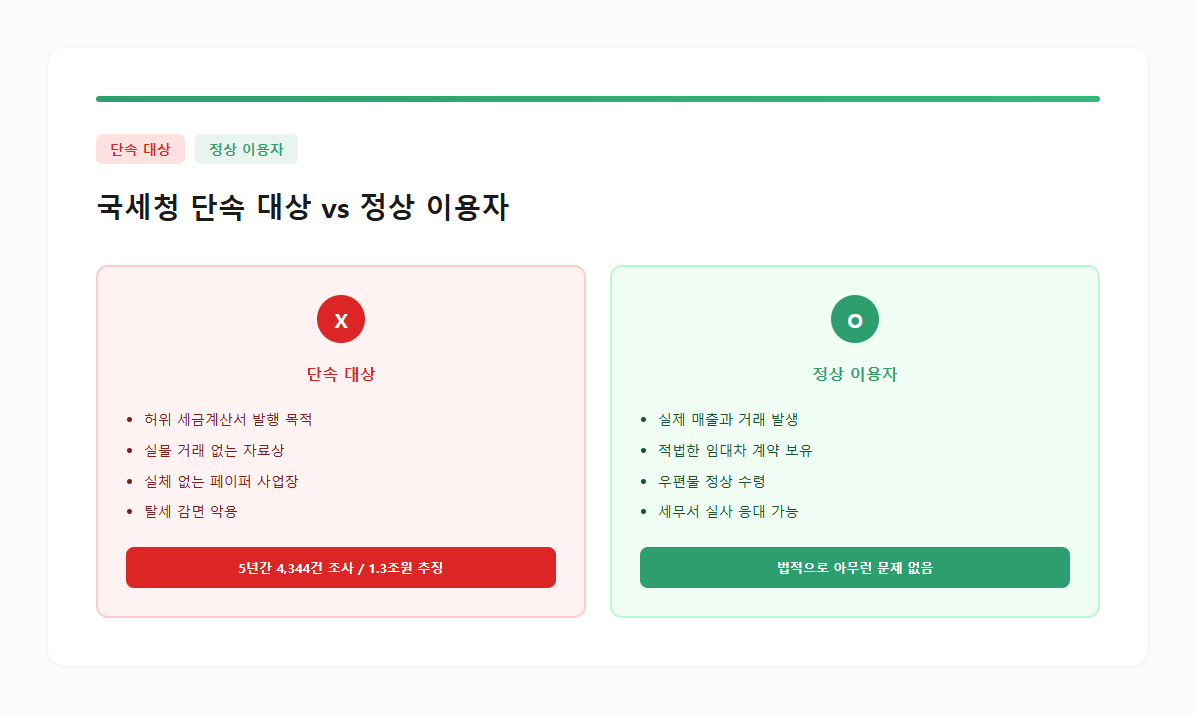
The tax authority watches virtual offices because of cases where they're abused for issuing false tax invoices and for "data-supplier" schemes. Here, a "data supplier" refers to a business that issues tax invoices without any actual transactions in exchange for a fee. The virtual office itself isn't the problem; the target of enforcement is tax evasion that uses such substance-less business premises.
In fact, over the past 5 years, the tax authority has conducted 4,344 tax audits of recipients of false tax invoices, with assessed taxes reaching 1.3317 trillion won. A primary enforcement target is the scheme where a data supplier merely borrows a virtual office address to register a business and then issues tax invoices without any real transactions.
For this reason, some tax offices tend to scrutinize business registrations more strictly in areas dense with virtual offices (Gangnam, Seocho, etc.). If an excessive number of businesses are registered at the same address, it may be judged a nominal address, leading to an on-site check (inspection) or a request for supplementation.
The important thing is that this stepped-up enforcement does not extend to businesses that use a virtual office normally. If you have actual business activity and a legitimate contractual relationship, you can maintain your business registration without any problem.
Where is the line between legal and illegal?
Whether a virtual office is legal or risky is determined by "substance." What the tax office ultimately wants to confirm is "Is business really being conducted at this address?" Even with the same virtual office, the line between legal and risky use depends on how you use it.
Using the 5 items below as criteria, check where the virtual office you use (or are about to use) falls.

[ Legitimate use vs. Risky use comparison ]
Lease agreement — Legitimate: holds a valid sublease agreement / Risky: just borrowing an address with no contract
Building use — Legitimate: neighborhood living facility or business facility / Risky: residential officetel, illegal building
Mail management — Legitimate: dedicated staff on-site, notified immediately on arrival / Risky: no management staff
Business substance — Legitimate: actual sales and transactions occur / Risky: only purpose is issuing tax invoices
Inspection response — Legitimate: has signage/facilities, able to respond / Risky: empty space, unable to respond
The contract, building use, and mail management system all become evidence supporting substance. If you're considering using a virtual office, we recommend comparing providers based on the 5 items above rather than just comparing prices.
👉 Worried your business registration will be rejected? See the virtual office rejection checklist
What conditions do you need to meet to use one legally?
To use a virtual office legally, you need to meet 4 essential conditions. These are the key items the tax office checks when judging the substance of a place of business.
1. A legitimate lease agreement
You should sign a formal sublease agreement (a contract where the original tenant re-leases to a third party) with the virtual office provider. The contract must clearly state the business address, the usage period, and the scope of use. A service that just lends you an address with no contract is a leading cause of business registration rejection.
2. Checking the use on the building register
You must confirm that the building is registered as a neighborhood living facility or a business facility. In a residential officetel or a building whose use hasn't been converted, business registration may be rejected.
You can view the building register for free on Gov24 (gov.kr). Access the site → search "building register" → enter the building's location → view (free), and you can check it right away.
3. Mail send/receive service
When tax office mail, government notices, and the like arrive at the address, it must be possible to receive, store, and forward them. If mail is returned undelivered, the tax office may doubt the substance of the place of business.
4. An inspection response system
There must be a system in place to respond when a tax office official comes for an on-site inspection. A place with on-site staff and a business nameplate or guidance system is advantageous.

Find a virtual office that fits your business
How does CoworkCity meet the legal requirements?
CoworkCity is a virtual office platform that has handled over 30,000 cumulative business registrations across 66 branches nationwide. It meets the 4 legal requirements explained above as follows.
Lease agreement: We provide a formal sublease agreement to every user. The contract clearly states the business address, usage period, and scope of service.
Building use: All 66 branches nationwide operate in buildings used as neighborhood living facilities or business facilities. Only buildings whose building register has been verified are selected as branches.
Mail management: Each branch has on-site staff, and we notify you immediately when mail arrives. Government mail, registered mail, and the like are also received and stored securely.
👉 Curious about the mail management service? CoworkCity mail management user guide
Inspection response: We have a management system in place that can respond to a tax office inspection. Services such as placing a business nameplate and handling visitors are included.

What criteria should you use to choose a virtual office?
Registering a business with a virtual office is a legitimate method grounded in the VAT Act. The key is "choosing a provider that can prove substance."
When picking a virtual office, don't just look at price or location—judge it by the 4 criteria below.
- Does it provide a formal sublease agreement?
- Is the use on the building register a neighborhood living facility or a business facility?
- Is there a mail reception/notification system?
- Is there an on-site staffing system that can respond to a tax office inspection?
If a place meets all of these criteria, you can use it with peace of mind, without worrying about business registration rejection.
All 66 of CoworkCity's branches nationwide meet the 4 requirements above. If it's your first business registration, start with a legitimately verified virtual office.
Find a virtual office near you
Frequently Asked Questions (FAQ)
Q. Do I pay more tax if I use a virtual office?
Using a virtual office does not result in any additional tax. VAT, comprehensive income tax, and the like are calculated based on sales and expenses, not the type of place of business. The virtual office fee (30,000–50,000 won per month) can be treated as a business-related expense, so it can actually help with tax savings.
Q. Can I register a business with a residential officetel?
A residential officetel has its use listed as "residential facility" on the building register, so business registration is likely to be rejected. For business registration to be possible, the use on the building register must be a business facility or a neighborhood living facility. For officetels, check the building register on Gov24 to see whether it's registered as a "business-use" building.
Q. Can I register a business right after signing a virtual office contract?
You can apply for business registration immediately upon signing. However, the tax office may request supplementation or conduct an on-site inspection during the review, so processing can take anywhere from 1 day to 2 weeks. If your documents are complete, it's usually processed within 3–5 business days.
Q. Can multiple people register their businesses at the same address?
Yes, they can. There's no legal problem with multiple businesses being registered at one virtual office address. It's the same principle as multiple businesses using the same building address in a commercial building. That said, if an excessive number of businesses are registered at the same address, it can become a target for a tax office inspection, so it's important to choose a provider with a proper management system.
Q. What happens if my virtual office business gets administratively closed?
An administrative closure is a measure where the tax office forcibly cancels a business registration when it determines there is no business substance. If you're administratively closed, you can no longer issue tax invoices, and if you have unpaid taxes, additional penalty taxes may be imposed. If you're operating your business normally, you won't be a target for administrative closure, so using a virtual office with a mail management and inspection response system in place is a preventive measure.
Related posts
👉 Curious about the specific procedure for registering a business legally? Virtual office business registration procedure guide (coming soon)
👉 To avoid being rejected: A checklist you must review if you're worried about your virtual office registration being rejected
👉 New to virtual offices? Everything about virtual offices, from someone in the field
👉 Want to understand VAT from the basics? VAT every business owner should know
