9 Deductible Expense Categories for Sole Proprietors — Does Virtual Office Rent Count?
We've rounded up 9 categories of expenses sole proprietors can deduct. Check whether virtual office rent is deductible too, along with the criteria updated for 2026.

Editor's Note
Have you ever seen cases where the tax differs by hundreds of thousands of won even for the same revenue?
For a sole proprietor, "expense deduction" isn't just an accounting term—it's a practical way to save on taxes. When you fully claim the costs you spent on your business as expenses, your taxable income drops, and your comprehensive income tax drops along with it.
But many people get confused about which items can actually be deducted and what documentation is required. This is especially true for items where you wonder, "Can this be deducted too?"—like virtual office rent.
In this post, we've put together the 9 most common expense items a sole proprietor can deduct, along with what's changed as of 2026.
ℹ️ Q1. What exactly is expense deduction (necessary expenses)?
Expense deduction means having costs directly related to your business activities recognized as necessary expenses and subtracted from your taxable income.
Put simply, the structure looks like this:
✅ Comprehensive income tax = (Total revenue − Necessary expenses) × Tax rate
If your total revenue is 50 million won and your necessary expenses are 20 million won, you're only taxed on 30 million won. If you don't properly claim your expenses, you could end up taxed on the full 50 million won, so it's important to carefully check that you're not missing anything.
That said, not every expense is deductible. It must be a cost directly related to your business, and you must have qualified documentation to have it recognized.
ℹ️ Q2. What are the 9 deductible expense items?
Here are the expense items sole proprietors use most often.

1. Rent (office rent and maintenance fees)
Business premises rent and maintenance fees are a classic necessary expense item. This includes rent for offices, shared offices, and virtual offices alike. You can document it with a tax invoice or a cash receipt.
2. Labor costs (employee salaries, severance pay, four major insurances)
If you employ staff, their salaries, bonuses, severance pay, and various allowances are all deductible. The employer's portion of the employees' four major insurances (national pension, health insurance, employment insurance, industrial accident insurance) is also recognized.
⚠️ Note: The owner's own salary is not deductible. This is because a sole proprietor's business income itself is treated as the owner's compensation.
3. Purchase costs (goods and raw materials)
The cost of purchasing raw materials needed to provide products or services for sale is, of course, deductible.
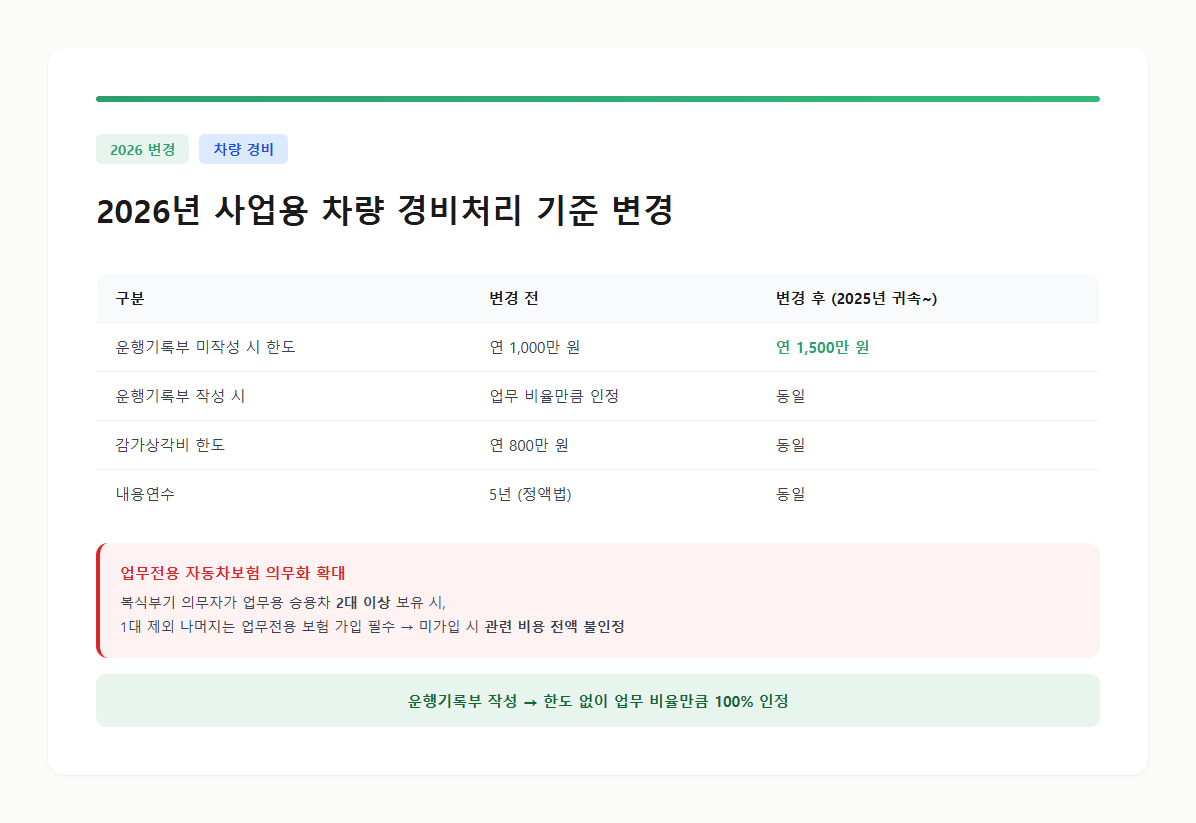
4. Business vehicle upkeep
This covers fuel, insurance premiums, repairs, lease fees, depreciation, and so on for business-use passenger vehicles.
• Without a driving log: capped at 15 million won per year (raised from the 2025 tax year onward) • With a driving log: recognized in proportion to business use (depreciation capped at 8 million won per year)
A double-entry-bookkeeping obligor who owns two or more vehicles must take out business-use auto insurance. Vehicles without it may have all related costs disallowed, so be sure to check.
5. Entertainment expenses
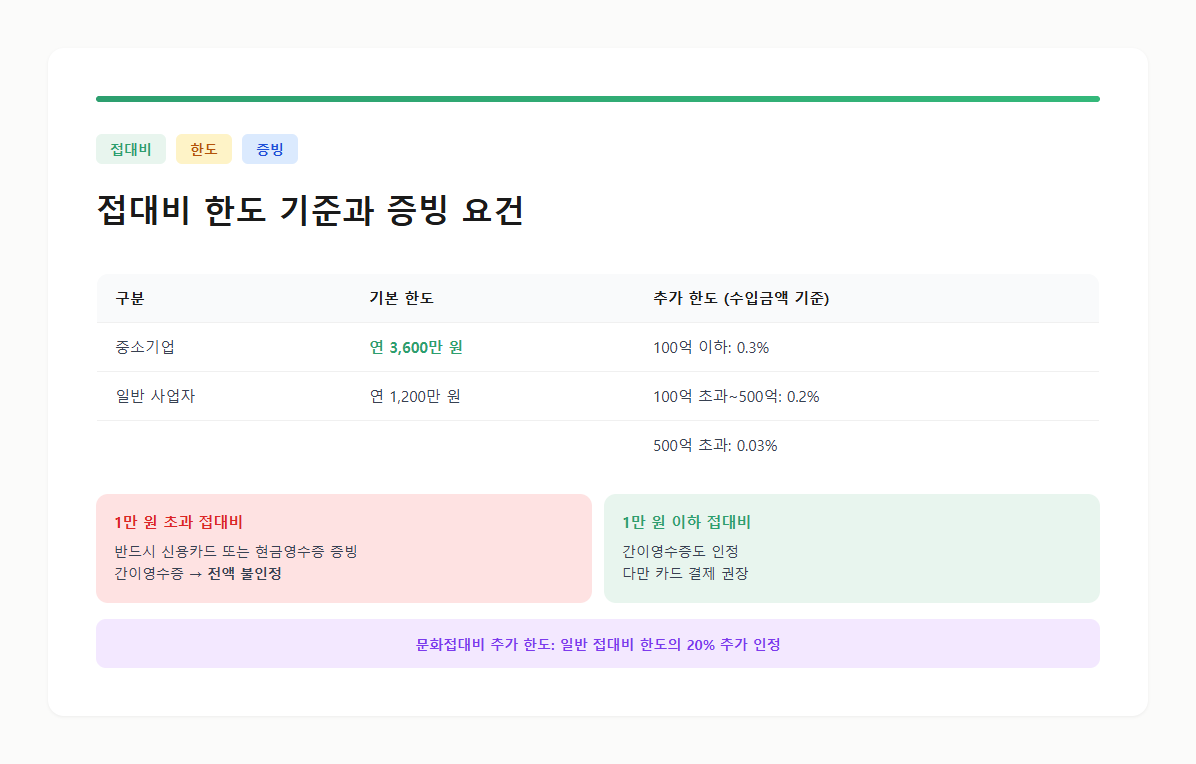
Meals, gifts, and condolence/congratulatory expenses with business partners fall under entertainment expenses.
• SMEs: basic cap of 36 million won per year • General businesses: basic cap of 12 million won per year • Additional cap: 0.3% of revenue (for revenue up to 10 billion won)
For entertainment expenses, anything over 10,000 won must be documented with a credit card or cash receipt. Simplified receipts won't be accepted.
6. Communication and internet fees
This includes mobile phones under the business's name (up to 5), office internet, and phone charges.
7. Advertising and promotion expenses
These are costs spent promoting your business, such as blog marketing, social media ads, Naver keyword ads, and flyer production.
8. Depreciation
When you buy business assets (computers, furniture, machinery, vehicles, etc.), you don't deduct them all at once—you spread the cost out over their statutory useful life.
• Business passenger vehicles: 5 years • Computers and peripherals: 4 years • Fixtures and furniture: 5 years • Buildings: 20–40 years
9. Other (utilities, insurance premiums, loan interest, etc.)
- Utilities: water, electricity, and gas for the business premises
- Insurance premiums: business-related insurance (fire insurance, liability insurance, etc.)
- Loan interest: interest on business-purpose loans (principal is not deductible)
- Training costs: costs spent on employee training
- Supplies: office supplies, copy paper, etc.
ℹ️ Q3. Is virtual office rent also deductible?
Yes, it is.
Virtual office rent qualifies as a necessary expense as business premises rent. Under Article 55 of the Enforcement Decree of the Income Tax Act, the rental cost of business premises directly used for the business is recognized as a necessary expense.
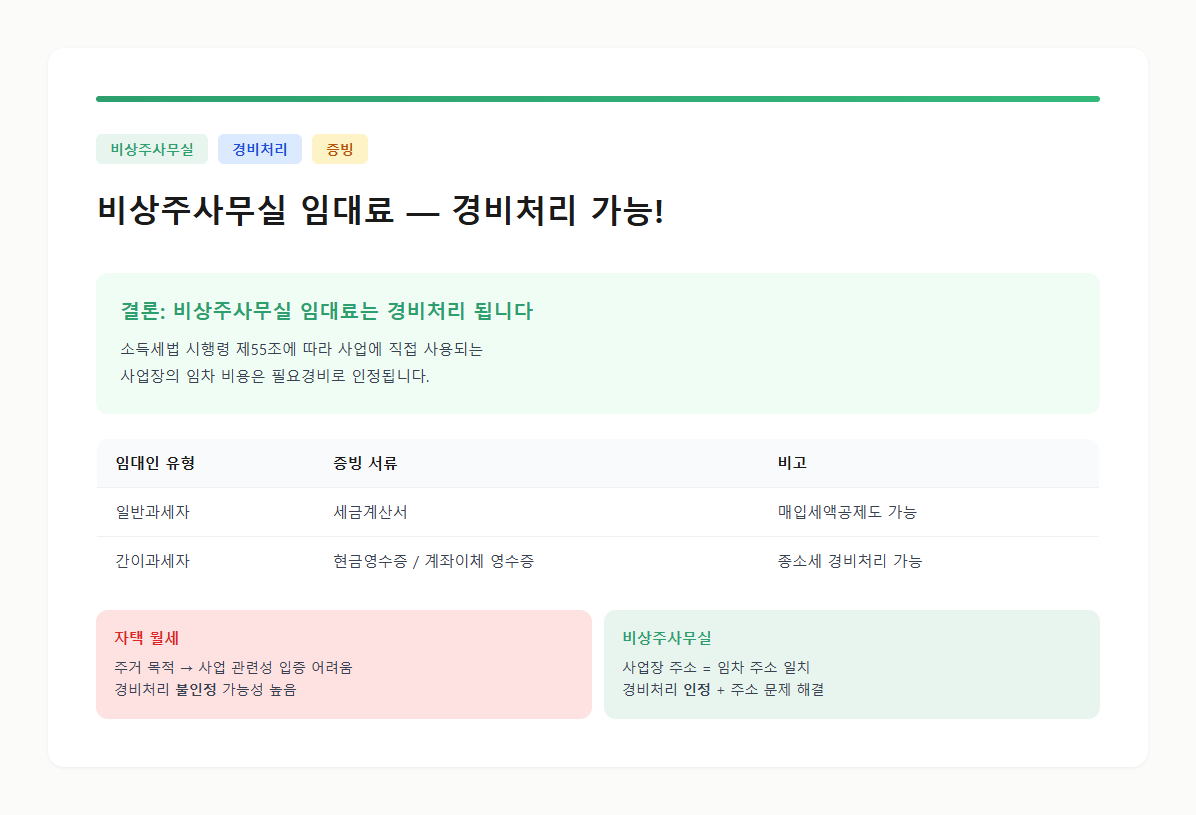
The documentation method is simple too:
• General taxpayer landlord: tax invoice • Simplified taxpayer landlord: cash receipt or bank transfer receipt
A virtual office usually costs around 10,000–30,000 won per month, but over 12 months that's 120,000–360,000 won. Even small amounts add up over time and have a tax-saving effect, so it's best not to leave them out.
For reference, deducting your home rent as business premises rent is likely to be disallowed because it's hard to prove the business connection. Since your business registration address must match the actual rented address, if you don't have a separate business address, using a virtual office is also advantageous from an expense-deduction standpoint.
Find a virtual office near you
ℹ️ Q4. What documentation do I need for expense deduction?
To deduct an expense, you need a statutory supporting document called "qualified documentation." There are four kinds in total.
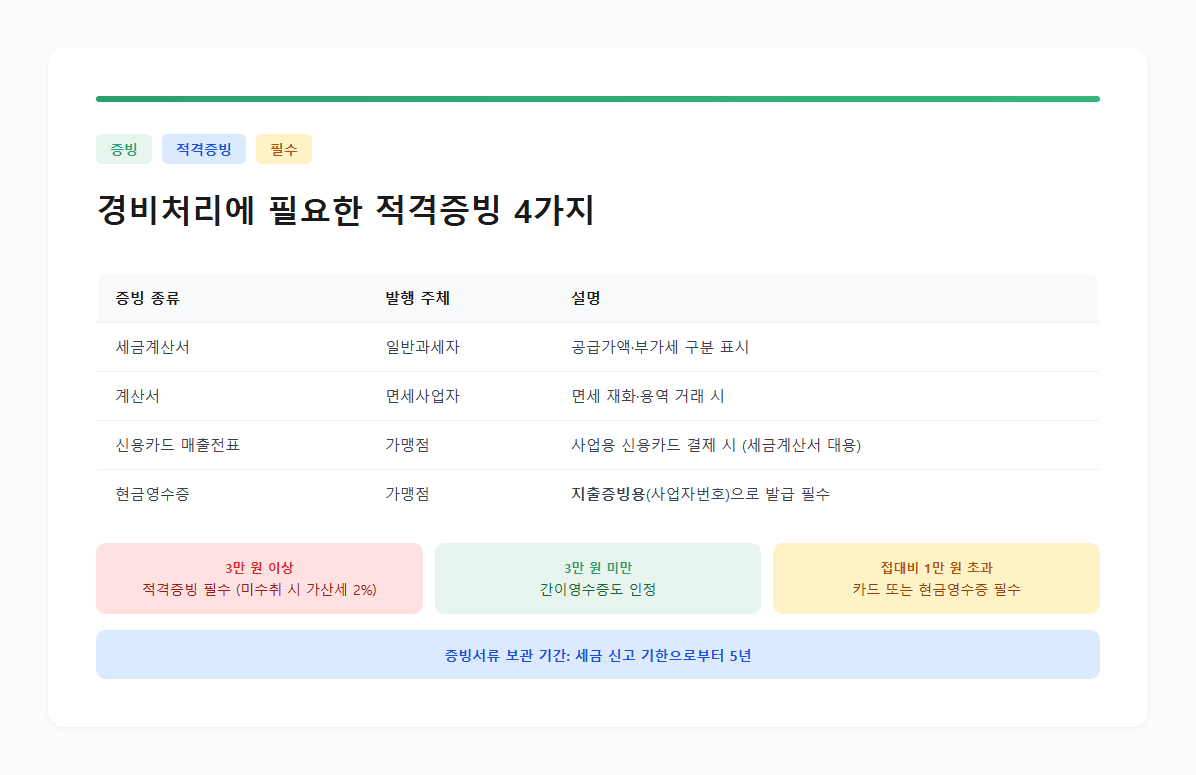
• Tax invoice: issued by a general taxpayer, with the supply value and VAT shown separately • Invoice: issued by a tax-exempt business • Credit card sales slip: when paid with a business credit card (can substitute for a tax invoice) • Cash receipt: must be issued for expense documentation under your business registration number
Documentation thresholds by amount
- 30,000 won or more: qualified documentation required (2% penalty tax if not obtained)
- Under 30,000 won: simplified receipts also accepted
- Entertainment expenses over 10,000 won: credit card or cash receipt required
You're required to keep supporting documents for 5 years from the tax filing deadline, so hold onto them.
✅ Registering your business credit card on Hometax makes documentation management much easier.
See how to register a business credit card on Hometax
ℹ️ Q5. What items are NOT deductible?
The items below are classic examples that either have no business connection or are legally not recognized as expenses.
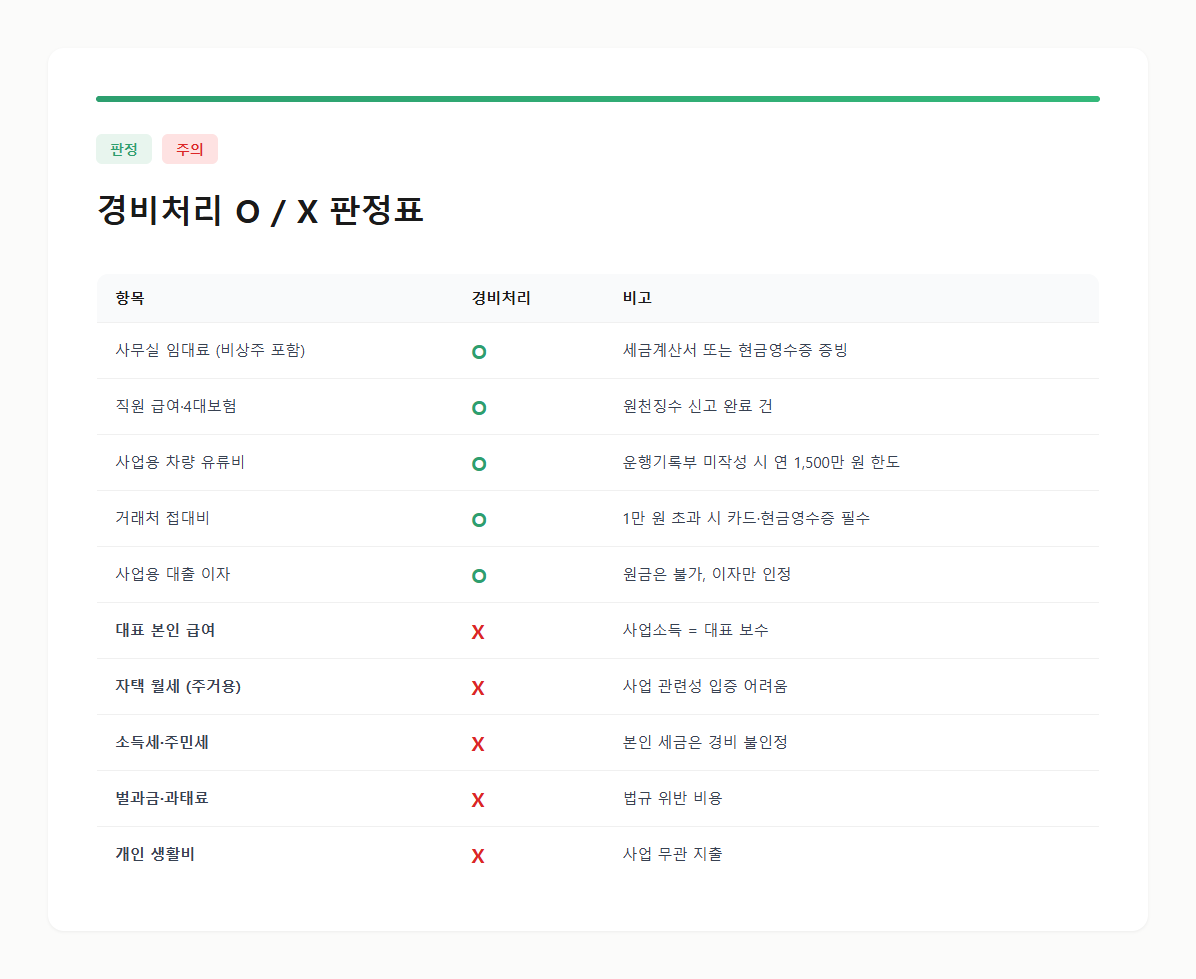
- Owner's own salary — the business income itself is treated as the owner's compensation
- Home rent (for residential purposes) — housing costs unrelated to the business
- Income tax and resident tax — your own taxes are not deductible
- Fines and penalties — costs related to legal violations
- Personal living expenses — spending with no business connection
- Undocumented expenses — disallowed without qualified documentation
- Alumni/club donations — donations of a private nature
ℹ️ Q6. Can simplified taxpayers also deduct expenses?
For comprehensive income tax filing, expense deduction applies the same way for simplified taxpayers and general taxpayers.
The difference shows up on the VAT side.
• VAT input tax credit: general taxpayers deduct the full amount; simplified taxpayers deduct only 0.5% of purchases • Comprehensive income tax expense deduction: applied identically • Issuing tax invoices: only general taxpayers can
In other words, even simplified taxpayers can receive the same expense deduction benefits in their comprehensive income tax filing as long as they have qualified documentation. They can't get a VAT refund, but the income tax savings are exactly the same.
✅ If you'd like to know more about the difference between simplified and general taxpayers, check out the post below.
VAT every business owner should know
ℹ️ Q7. Are there any changes to the expense deduction rules in 2026?
Here are the key changes that apply from 2026 (the 2025 tax year).
Higher cap on business passenger vehicle expense recognition
• Before: capped at 10 million won per year without a driving log • After: capped at 15 million won per year (from the 2025 tax year)
You can now have up to 15 million won per year recognized even without keeping a driving log. However, to deduct more than that, you still need to keep a driving log.
Expanded mandatory business-use auto insurance
If a double-entry-bookkeeping obligor owns two or more business passenger vehicles, all but one of the vehicles must be covered by business-use auto insurance. Vehicles without it will have all related costs fully disallowed, so caution is needed.
✅ Sole proprietor expense deduction: just remember these
- Deductible items: rent, labor costs, purchases, vehicle upkeep, entertainment, communication, advertising, depreciation, utilities/insurance/interest, etc.
- Virtual office rent: deductible (documented with a tax invoice or cash receipt)
- The 4 types of qualified documentation: tax invoice, invoice, credit card sales slip, cash receipt
- Expenses of 30,000 won or more require qualified documentation (2% penalty tax if not obtained)
- 2026 change: vehicle expense cap raised from 10 million to 15 million won per year
- Simplified taxpayers get the same comprehensive income tax expense deduction

Wrapping up
Expense deduction isn't some grand tax-saving strategy—it starts with fully claiming the costs you spent on your business.
Small items that are easy to overlook—virtual office rent, business credit card transactions, communication fees—add up to a fairly large amount over a year. We recommend reviewing them once before you file your comprehensive income tax this year.
If your business registration address is still your home and that makes expense deduction difficult, using a virtual office is one option. For a cost of around 10,000–30,000 won per month, you can solve both the business address problem and expense deduction at the same time.
