How to Transfer a Sole Proprietorship: Why It Means Closing and Re-Registering
Unlike a corporation, a sole proprietorship usually isn't kept alive by simply changing the name on it — instead, the existing business is wound down and a new registration is filed under the new owner. This article explains how a change of ownership for a sole proprietorship actually works, why the close-and-re-register route is necessary, and what to check before you proceed.

Editor's Note While running a sole proprietorship, situations arise where you need to change the business owner's name — handing the business to a spouse, a succession within the family, or switching to someone else's name due to your own credit issues. The reasons vary. One common route people turn to here is "closing and re-registering." Because a sole proprietor — unlike a corporation — can't directly transfer the registration itself, you close the existing business and re-register under the new owner's name.
In this article, we've laid out the procedures and cautions worth knowing when changing ownership via the close-and-re-register route.
ℹ️ Q1. Why is a sole proprietor's change of ownership done by closing and re-registering?
A sole proprietor's registration number is issued based on the owner's resident registration number. In other words, because the registration number itself is bound to a specific individual, changing only the name is fundamentally impossible.
So to change ownership, you go through the following steps.
- The existing owner (A) files for closure ↓
- The new owner (B) applies for a new business registration ↓
- If needed, the lease, trade-name use, etc. are changed to the new owner
Legally, it's handled not as a "change of name" but as two separate procedures: "closure and new registration."
ℹ️ Q2. In what order do you close and re-register?
When closing and re-registering for the purpose of changing ownership, the following order is typical.
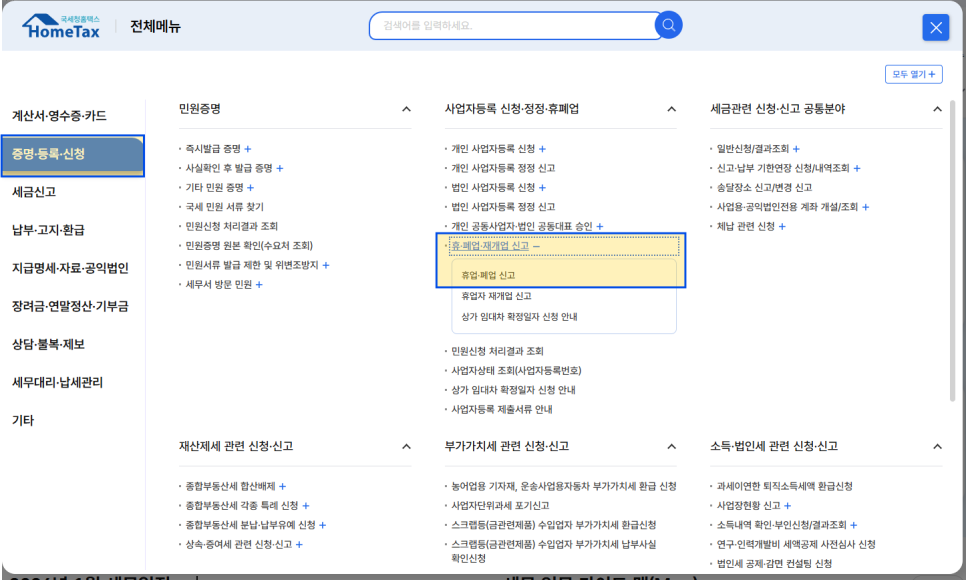
2-1. File closure of the existing business File the closure via Hometax or your local tax office. The closure date is processed as of the filing date, and the moment the closure filing is submitted, the registration number loses effect.
2-2. Settle taxes and check for arrears Settle VAT, comprehensive income tax, etc. incurred up to the closure date. If there are tax arrears, it's safer to clear them before the new registration.
2-3. Wind down business-premises contracts Change or re-sign the lease, trade-name rights, and telecom/electricity contracts to the new owner.
2-4. Apply for business registration under the new name The new owner (B) fills out and submits the registration application. The business address, industry, and trade name can be kept the same as before.
2-5. Issue the certificate and resume business Once the new business registration certificate is issued, use that number to notify clients, open a bank account, and re-register the card terminal.
ℹ️ Q3. Is it fine to re-register with the same industry at the same location?
It's legally possible, but it's an area that needs tax-related care. If you close and immediately re-register in the same industry at the same location, the tax authority may judge that you "didn't actually close." It can become a problem especially in the following cases.
ℹ️ Q4. Can changing only the name cause tax problems?
Yes. If it's deemed a name-only change, tax disadvantages can arise. For example, if you close under your own name and continue the same business under a spouse's or lineal family member's name, the NTS may view it as "name lending" or "concealing the real operator."
Be especially careful when the following overlap:
- The business address is the same
- The industry and clients are the same
- The gap between closure and new registration is short
- The previous owner had a history of arrears
In this case, the new owner may face joint tax liability for past arrears, or additional penalties. So if your purpose is a change of ownership, it's important to also have the substantive transfer procedures in place (signing contracts, transferring assets, etc.).
Q5. How should you prepare the business address? The first thing you need for a new business registration is a business address. For industries that don't require actual office space, using a virtual office is worth considering.
A virtual office lets you receive the address and mail-receiving service needed for business registration without renting an actual office. Especially for online businesses, freelancers, and solo entrepreneurs who don't need physical office space, it can greatly reduce the cost burden. Recently, spaces like CoworkCity that provide virtual offices in major areas nationwide have been increasing. Because it offers not just an address but add-on services like mail management and partner benefits, it can be a practically useful option.
That said, if you use a virtual office, check the following.
- Whether the address is in a building where business registration is possible
- Whether a lease or use-consent letter can be issued
- Whether the mail receipt and forwarding system is clear
Since the business address must continue to be maintained even after the change of ownership, choosing a trustworthy place is important.
Q6. What must you check when closing and re-registering? When closing and re-registering for the purpose of changing ownership, be sure to review the following.
- Whether closure is complete: confirm on Hometax that the closure was processed normally.
- Clearing tax arrears: if there are unpaid taxes, complete payment or an installment request before the new registration.
- Changing the lease name: change the business-premises lease to the new owner or re-sign it.
- Checking trade-name rights: if you keep using the existing trade name, confirm there are no legal issues with its use.
- Notifying clients and financial institutions: re-register tax invoices, accounts, card terminals, etc. under the new registration number.
- Succeeding insurance and permits: if your industry requires a business permit, hygiene-education completion, etc., redo them under the new name.
····························································································································································
Key Summary
A sole proprietor can't transfer the registration itself, so a change of ownership is done by closing and re-registering. The order is: file closure → settle taxes → change contracts → new registration.
Re-registering immediately with the same industry and location can cause tax disadvantages.
If it looks like a name-only change, penalties and joint tax liability can be imposed.
A new business registration requires a business address, and a virtual office can be used.
It's safest to have the substantive transfer procedures in place and to consult an expert when needed.
So how should you decide in the end?
Closing and re-registering is the most common way to change a sole proprietor's ownership, but it doesn't end with just swapping paperwork. Because the tax authority closely examines whether a genuine business succession took place, it's important to handle contracts, asset transfers, and tax settlement transparently so it doesn't look like a formality.
Especially if there's a history of arrears or you're re-registering under the same conditions, consulting a tax accountant to check the risks in advance can be the safe choice. And if you need a business address, we recommend also considering options like a virtual office that allow registration without physical workspace.