Do Freelancers and Solo Founders Really Need a Virtual Office?
We compare how much freelancers and solo founders can save on taxes by registering a business with a virtual office, versus using a home address.

Key Summary (TL;DR)
- When a freelancer registers a business, they escape the 3.3% withholding structure and can get VAT refunds and deduct expenses, increasing their real income.
- If you register a business at your home address, your home address is disclosed on the business registration certificate, and if you're renting (jeonse or monthly), you need your landlord's consent to subleasing.
- A virtual office solves both securing a business registration address and protecting your privacy at the same time, for 30,000–50,000 won per month.
- Choosing a virtual office outside the metropolitan overconcentration control zone lets you avoid the 3x heavier registration license tax when converting to a corporation.
- If you're 34 or younger, you can receive the young entrepreneur SME tax reduction (50–100% income tax reduction for 5 years), and an address outside the overconcentration control zone is the key condition that raises the reduction rate.
"I thought I was done after just 3.3% was withheld—but you're telling me I have to pay millions more at comprehensive income tax time?" If you've experienced this as a freelancer, you've probably considered the option of business registration at least once.
When you register a business, you can deduct expenses and get VAT refunds—but the problem is the "business address." Using your home address raises privacy concerns, and renting an office is a financial burden.
In this post, we lay out how freelancers and one-person businesses can use a virtual office to handle everything at once, from business registration to tax savings.
What changes when a freelancer registers a business?
When a freelancer registers a business, they escape the 3.3% withholding structure and can have their business expenses officially recognized. This is the biggest practical benefit of business registration.
If you work as a freelancer without business registration, 3.3% (3% income tax + 0.3% local income tax) is withheld from your service fees. Later, when you file comprehensive income tax in May, you apply the simplified expense rate (60–80% by industry), but it's hard to individually document the actual costs that went into your business.
By contrast, when you register a business, you can issue tax invoices, and the scope of expense deduction broadens considerably through your business credit card and cash receipts. Freelancers with annual income of 50 million won or more can expect an additional 1.5–3 million won in tax savings on average when they keep books after registering a business.
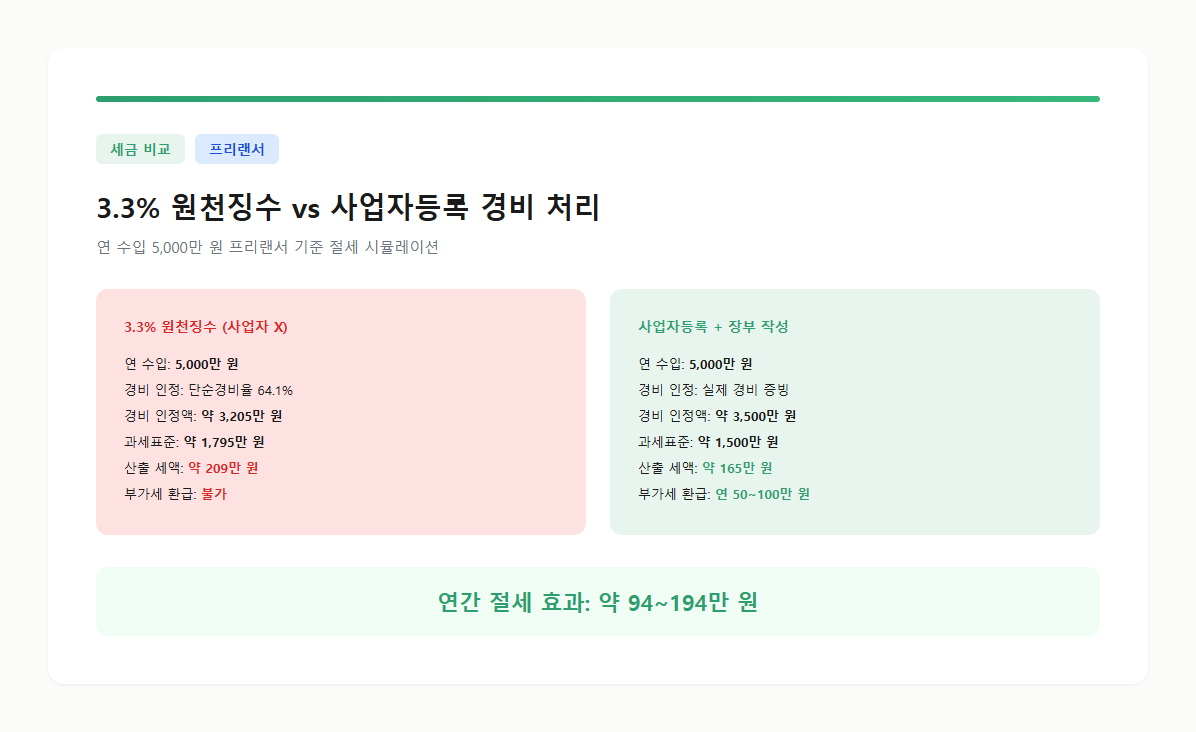
Tax-saving simulation for a freelancer with 50 million won in annual income
- 3.3% withholding (no business registration): apply simplified expense rate of 64.1% → tax base ~17.95 million won → calculated tax ~2.09 million won / no VAT refund
- Business registration + bookkeeping: actual expense documentation → tax base ~15 million won → calculated tax ~1.65 million won / VAT refund of 500,000–1 million won per year possible
- Annual tax-saving effect: ~940,000–1.94 million won
⚠️ The simulation above is an estimate applying a 64.1% simplified expense rate for the service industry (940909). Actual savings vary by industry, expense scale, and deduction items, so consulting a tax accountant is recommended.
Here's the key. If you're a freelancer with annual income exceeding 24 million won, you can reduce your tax burden just by registering a business and keeping a simplified ledger. Even accounting for tax accountant fees (300,000–500,000 won per year), it's a structure that more than pays off.
What problems arise if you set your business address to your home?
When you register a business at your home address, your home address is recorded as is on the business registration certificate. Because this address is disclosed on the National Tax Service's Hometax, on tax invoices to clients, and in the e-commerce/mail-order business report when running an online store, a risk of personal information exposure arises.
Three problems in particular come up often.
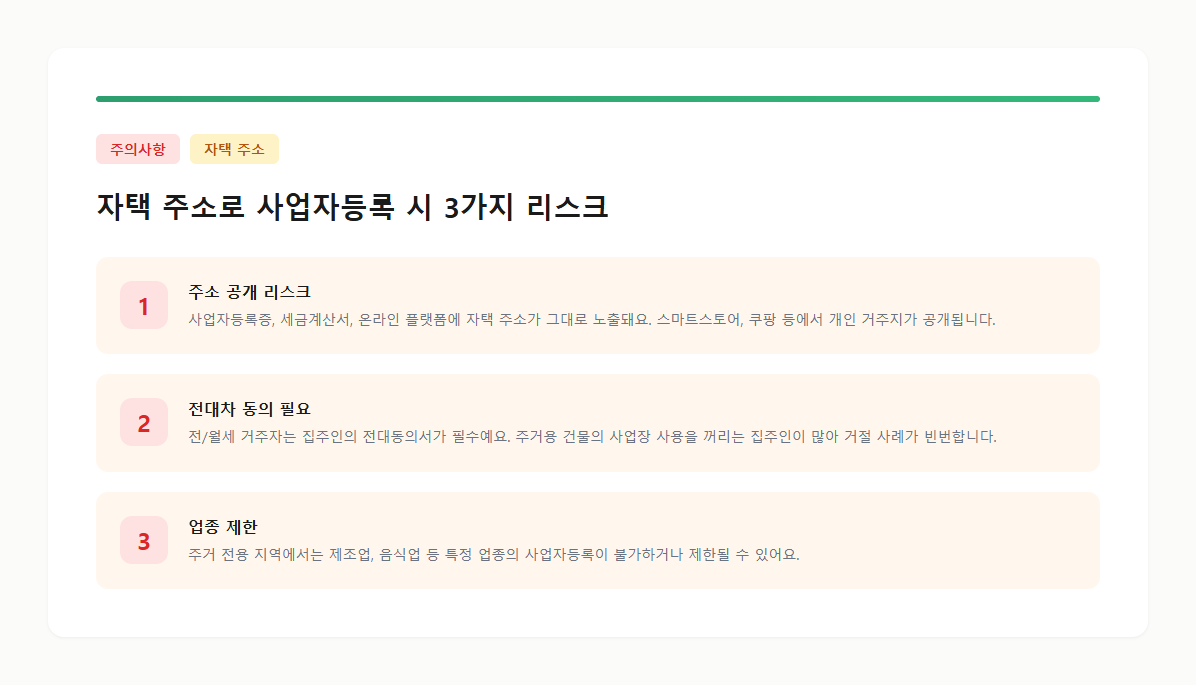
First, there's an address disclosure risk. When platforms like Smart Store, the Coupang marketplace, and Kmong publish business information, your home address is exposed as is. Cases where online store operators experienced unwanted visits or mail due to their home address being disclosed are frequently reported in startup communities.
Second, if you're renting (jeonse or monthly), you need your landlord's consent. You need to obtain your landlord's sublease consent in the form of a sublease (a contract where the original tenant re-leases to a third party). Many landlords are reluctant to have a residential building used as a place of business, so it's not uncommon to be refused.
Third, registration may be restricted depending on the business type. In residential-only zones, business registration for certain business types (manufacturing, food service, etc.) may be impossible or restricted.
What value does a virtual office offer freelancers?
A virtual office is an office where a business owner receives services such as a business registration address and mail reception without actually being present there. For freelancers, a virtual office offers three core values.
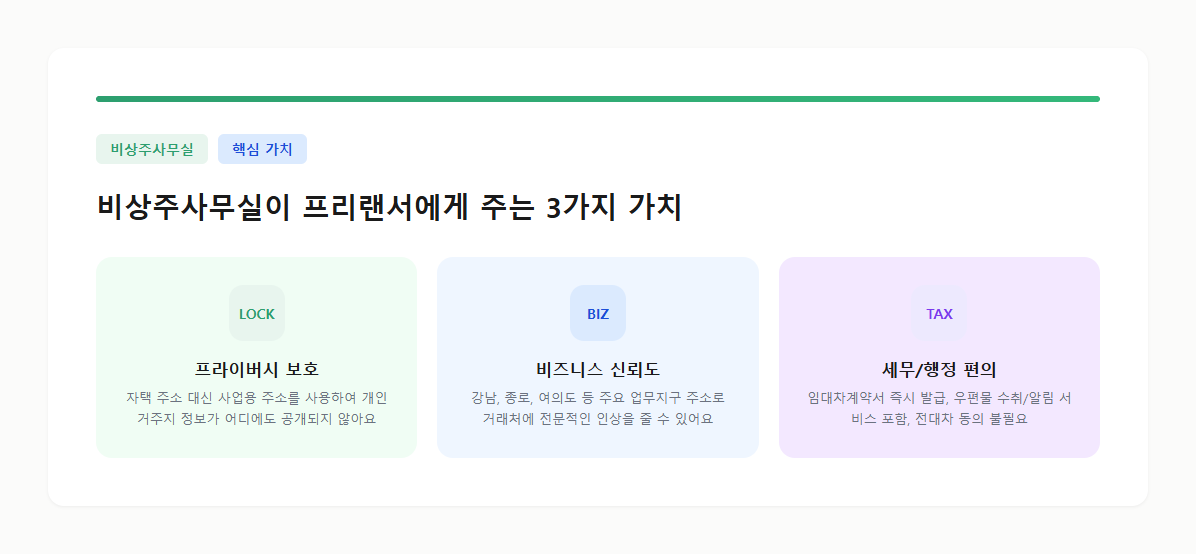
1. Privacy protection — Since you use a business address instead of your home address, your personal residence isn't disclosed. Your home address isn't exposed anywhere—not on the business registration certificate, tax invoices, or online platforms.
2. Business credibility — You can use an address in a major business district like Gangnam, Jongno, or Yeouido as your business address. It can give clients and customers a professional impression.
3. Tax and administrative convenience — You can get the lease agreement needed for business registration issued instantly, and mail reception/notification services are included. You can proceed with business registration right away, without the hassle of getting a sublease consent form.
If you're curious whether a virtual office is recognized as a legitimate place of business, you can find the details in Is registering a business with a virtual office legal? The latest 2026 standards explained.
A 30,000–50,000 won monthly investment—what's the actual tax-saving effect?
A virtual office costs around 30,000–50,000 won per month. Annualized, that's 360,000–600,000 won—and this cost itself is also recognized as a business expense.
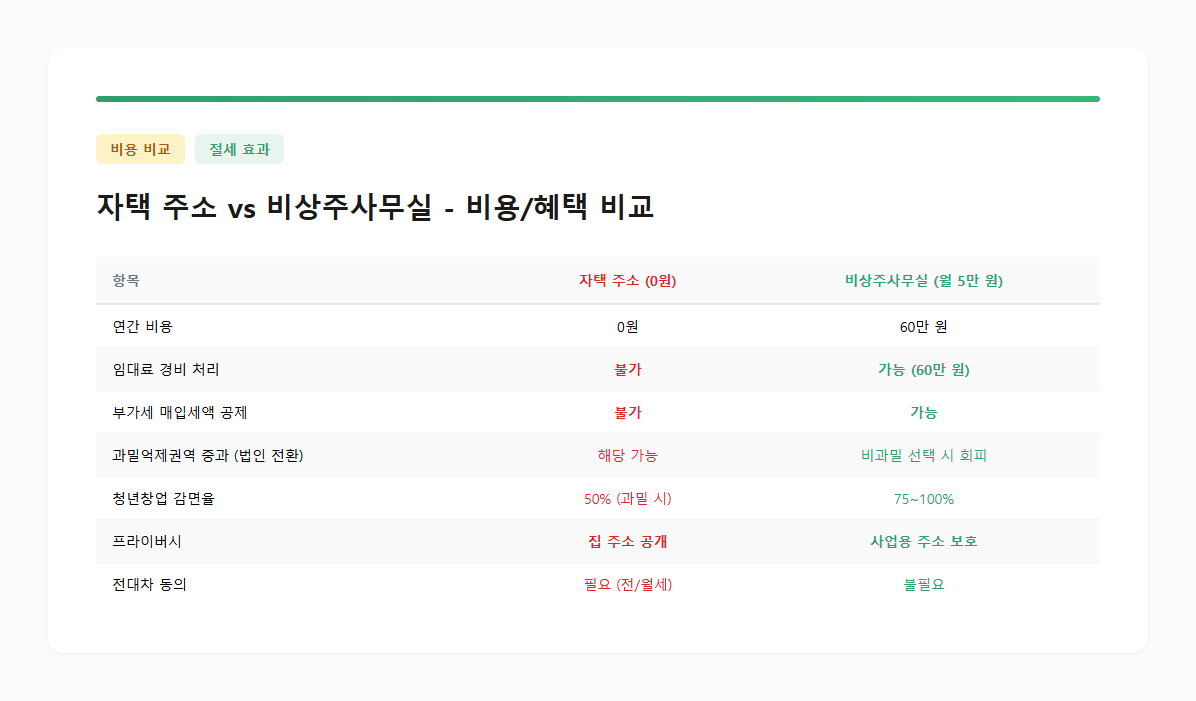
- Annual cost: home 0 won vs. virtual office 600,000 won
- Rent expense deduction: home not allowed vs. virtual office allowed (600,000 won recognized as expense)
- VAT input tax credit: home not allowed vs. virtual office allowed
- Overconcentration control zone surcharge (upon converting to a corporation): home possibly applicable vs. virtual office avoidable by choosing a non-overconcentration location
- Young entrepreneur reduction rate: home 50% (if in overconcentration zone) vs. virtual office 75–100%
- Privacy: home address disclosed vs. virtual office business address protected
- Sublease consent: home required (jeonse/monthly) vs. virtual office not required
The overconcentration control zone refers to an area designated under the Seoul Metropolitan Area Readjustment Planning Act as a region with excessively concentrated population and industry. It covers all of Seoul, parts of Incheon, and parts of Gyeonggi Province (Seongnam, Goyang, Suwon, etc.).
If you establish a corporation in an overconcentration control zone, the registration license tax is surcharged 3x. Based on capital of 100 million won, the registration license tax in a non-overconcentration area is about 400,000 won, but in an overconcentration area you'd pay about 1.2 million won. This difference alone is more than enough to offset the annual cost of a virtual office (360,000–600,000 won).
CoworkCity's main branches outside the overconcentration control zone
CoworkCity operates over 160 branches nationwide, and its main branches located outside the overconcentration control zone are as follows.
- Guro-gu, Seoul: 3 branches in Guro Digital Complex — located within an industrial complex, broad range of eligible business types
- Geumcheon-gu, Seoul: 2 branches in Gasan Digital Complex — choice of buildings used as neighborhood living facilities or factories
- Southern Gyeonggi: Anyang, Gunpo, Uiwang, etc. — non-overconcentration + access to Seoul
- Non-overconcentration Incheon: Namdong-gu, Yeonsu-gu, etc. — non-overconcentration areas within Incheon
You can check CoworkCity's full branch list and regional pricing on the CoworkCity offices page.
If you're 34 or younger, here's the young entrepreneur tax reduction you must know
The young entrepreneur SME tax reduction is a program where a young person aged 15 to 34 who starts a business for the first time gets their income tax (or corporate tax) reduced for 5 years starting from the year income is generated. For businesses started on or after January 1, 2026, the reduction rate has been subdivided by region.
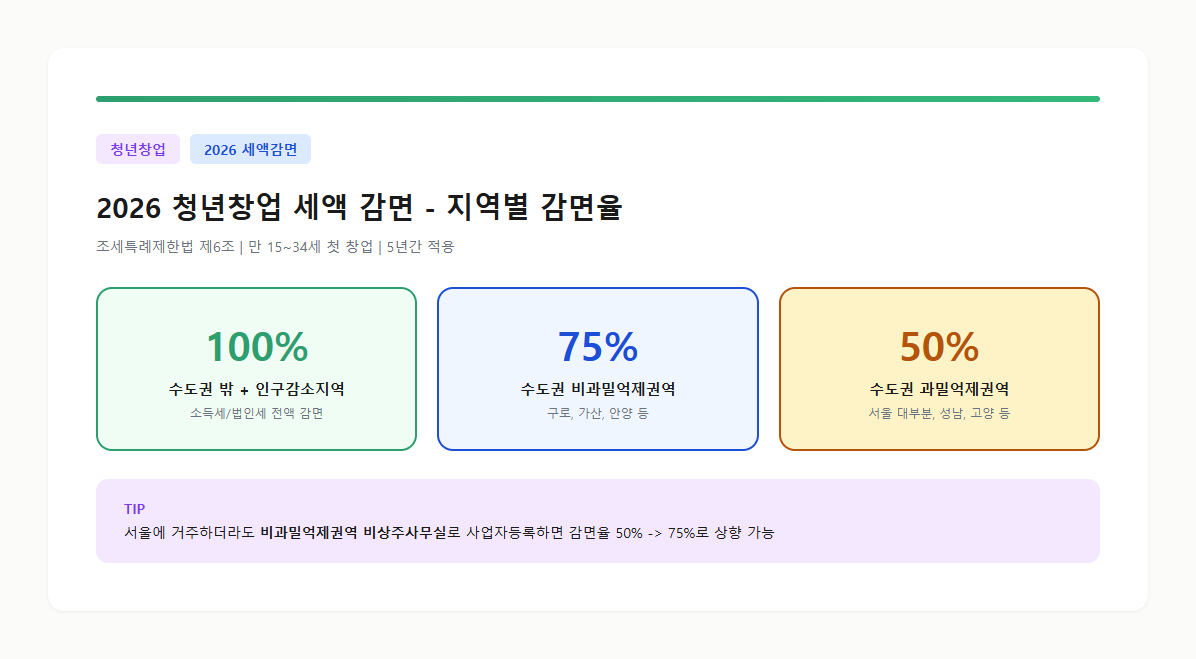
ℹ️ 2026 young entrepreneur tax reduction rates (Article 6 of the Restriction of Special Taxation Act) ℹ️ - Outside the metropolitan area + population-decline region: 100% (5 years) ℹ️ - Within the metropolitan area, non-overconcentration control zone: 75% (5 years) ℹ️ - Metropolitan overconcentration control zone: 50% (5 years)
The key point is that the address of the virtual office becomes the location of your place of business. Even if your home is in the metropolitan overconcentration control zone (most of Seoul), if you register your business with a virtual office located in a non-overconcentration control zone, you can apply the 75% reduction rate. The reduction rate that would have stayed at 50% had you registered with your home address is raised by 25 percentage points.
Since military service is subtracted from the age calculation (up to 6 years), you can actually qualify as a "young person" up to age 40.
You can find the detailed requirements of the young entrepreneur tax reduction and the 2026 changes in A complete guide to government support programs for those preparing to start a business in 2026.
Which freelancers do we recommend a virtual office for?
5 recommended types
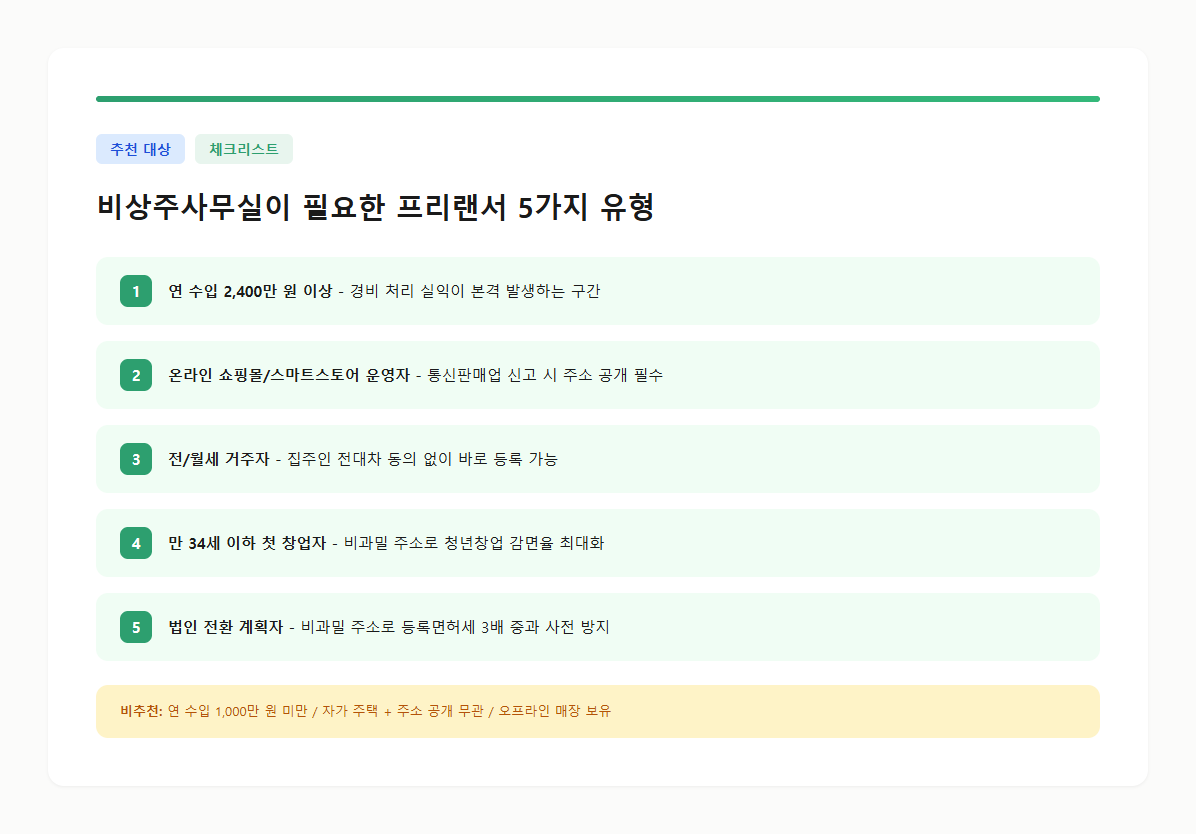
1. Freelancers with annual income of 24 million won or more — This is the bracket where the practical benefit of expense deduction really kicks in after business registration.
2. Online store / Smart Store operators — Since your business address is disclosed when filing the e-commerce/mail-order business report, privacy protection is needed.
3. Renters (jeonse or monthly) — When the landlord's sublease consent is hard to get, a virtual office is the most realistic alternative.
4. First-time founders aged 34 or younger — A virtual office in a non-overconcentration control zone lets you maximize the young entrepreneur tax reduction rate.
5. Freelancers planning a future conversion to a corporation — A non-overconcentration address lets you prevent the 3x heavier registration license tax in advance.
Not recommended for
- Cases where annual income is under 10 million won and the practical benefit of business registration isn't significant
- Cases where you live in a home you own and aren't sensitive about address disclosure
- Cases where you have an offline store and don't need a separate business address
Wrapping up — The difference a 30,000-won monthly investment makes
For freelancers, a virtual office isn't just renting an address. It's an investment that lowers the entry barrier to business registration and changes your long-term cost structure—from expense deduction and tax reductions to tax savings when converting to a corporation.
For a freelancer with annual income of 30 million won or more, a virtual office cost of 30,000–50,000 won per month is an amount that more than pays for itself in terms of tax savings, privacy protection, and business credibility.
CoworkCity provides virtual offices from around 10,000 won per month across over 160 branches nationwide. We guarantee a 100% refund if your business registration is rejected, and the lease agreement is issued within 5 minutes.
Check CoworkCity virtual office branches
If you're torn between a virtual office and a shared office, also take a look at Everything about virtual offices, from someone in the field.
Frequently Asked Questions
프리랜서 사업자등록 업종코드는 무엇인가요?
프리랜서 업종코드는 직종에 따라 달라요. IT 개발은 620200(소프트웨어 개발업), 디자인은 740300(전문디자인업), 유튜버·크리에이터는 921505(미디어 콘텐츠 창작업) 또는 940909(기타 자영업)를 많이 사용해요. 국세청 홈택스에서 업종코드를 검색할 수 있고, 하나의 사업자등록에 여러 업종코드를 등록할 수도 있어요.
부업으로 사업자등록하면 본업 직장에 알려지나요?
사업자등록 자체가 직장에 통보되지는 않아요. 다만 5월 종합소득세 신고 시 근로소득과 사업소득이 합산되면서 6월에 발송되는 건강보험료 추가 고지서를 통해 간접적으로 알려질 수 있어요. 이를 방지하려면 건강보험공단에 별도 사업장 가입 신청을 하는 방법이 있으므로 세무사와 상담하는 것을 권장해요.
간이과세자와 일반과세자 중 무엇을 선택해야 하나요?
연 매출 1억 400만 원 미만(2026년 기준)이면 간이과세자로 등록할 수 있어요. 간이과세자는 부가세 부담이 낮지만 세금계산서 발행에 제한이 있어요. 거래처가 세금계산서를 요구하거나, 매입세액 환급을 받고 싶다면 일반과세자가 유리해요. 프리랜서 대부분은 초기에 간이과세자로 시작한 후 매출 규모에 따라 전환해요.
비상주사무실 비용은 경비 처리가 가능한가요?
비상주사무실 임대료는 사업장 임차료로 경비 처리가 가능해요. 세금계산서를 발급받으면 부가가치세 매입세액 공제도 받을 수 있어요. 코워크시티의 경우 매월 전자세금계산서를 자동 발행하므로 별도 요청 없이 경비 처리 증빙이 확보돼요.
사업자등록 후 매출이 없어도 괜찮나요?
사업자등록 후 매출이 없어도 법적으로 문제되지 않아요. 다만 부가세 신고 기간(1월, 7월)에 무실적 신고를 해야 해요. 홈택스에서 간단히 처리할 수 있어요. 장기간(1년 이상) 매출이 전혀 없으면 세무서에서 사업 실체 확인 요청이 올 수 있으므로, 사업 준비 상태라면 관련 경비 내역을 정리해 두는 것이 좋아요.
유튜버·인플루언서도 비상주사무실을 사용하나요?
유튜버·인플루언서는 비상주사무실의 대표 이용 업종 중 하나예요. 특히 MCN 소속이 아닌 개인 크리에이터가 사업자등록을 할 때, 촬영 장소와 별도로 사업장 주소가 필요하므로 비상주사무실을 활용하는 경우가 많아요. 코워크시티에서도 유튜버·크리에이터 업종의 사업자등록을 지원하고 있어요.
