VAT: What Every Business Owner Needs to Know
We've laid out the basics of VAT and how to file it — essential knowledge for any business owner. From the difference between general and simplified taxation, to how sales and purchase VAT are calculated, to why you still need to file even with zero sales. Even first-time founders can grasp the essentials of VAT from this single article.

Editor's Note
Once you start a business, you run into taxes sooner than you'd expect. Among them, VAT is a tax many owners feel they vaguely understand — until they actually have to explain it. It's common to scramble to look it up only as the deadline nears, or to finish filing and only then wonder, "Was that the right way to do it?" Rather than explaining tax jargon the hard way, this article calmly lays out how to think about VAT from an operator's perspective. We hope it helps not only those just starting out, but also those already in business who want a refresher.
Take another step toward becoming a pro entrepreneur with CoworkCity.
ℹ️ The Complete VAT Guide Every Business Owner Needs
The first tax you meet when you start a business is VAT. Familiar as a consumer, it's something you must understand from a completely different angle once you're a business owner. Today we'll lay out everything from the basics of VAT to the practical essentials, in plain terms.
ℹ️ What exactly is VAT?
VAT is a tax levied each time new value is added to a good or service. In Korean, "부가" means "added" and "가치" means "value." It's the tax you always see on a receipt when you buy something. Here's the key point: VAT is borne by the final consumer, but it's the business that files and remits it. In simple terms, the business plays a middle role — collecting the tax from consumers on the government's behalf and remitting it.
✅ Pre-filing VAT checklist
To file VAT, you need to grasp three key elements.
✔️ Taxation type — general or simplified
✔️ Sales — how much you earned
✔️ Purchases — how much you spent
Now let's look at each in detail.
ℹ️ Taxation type: general vs. simplified
VAT splits broadly into two types.
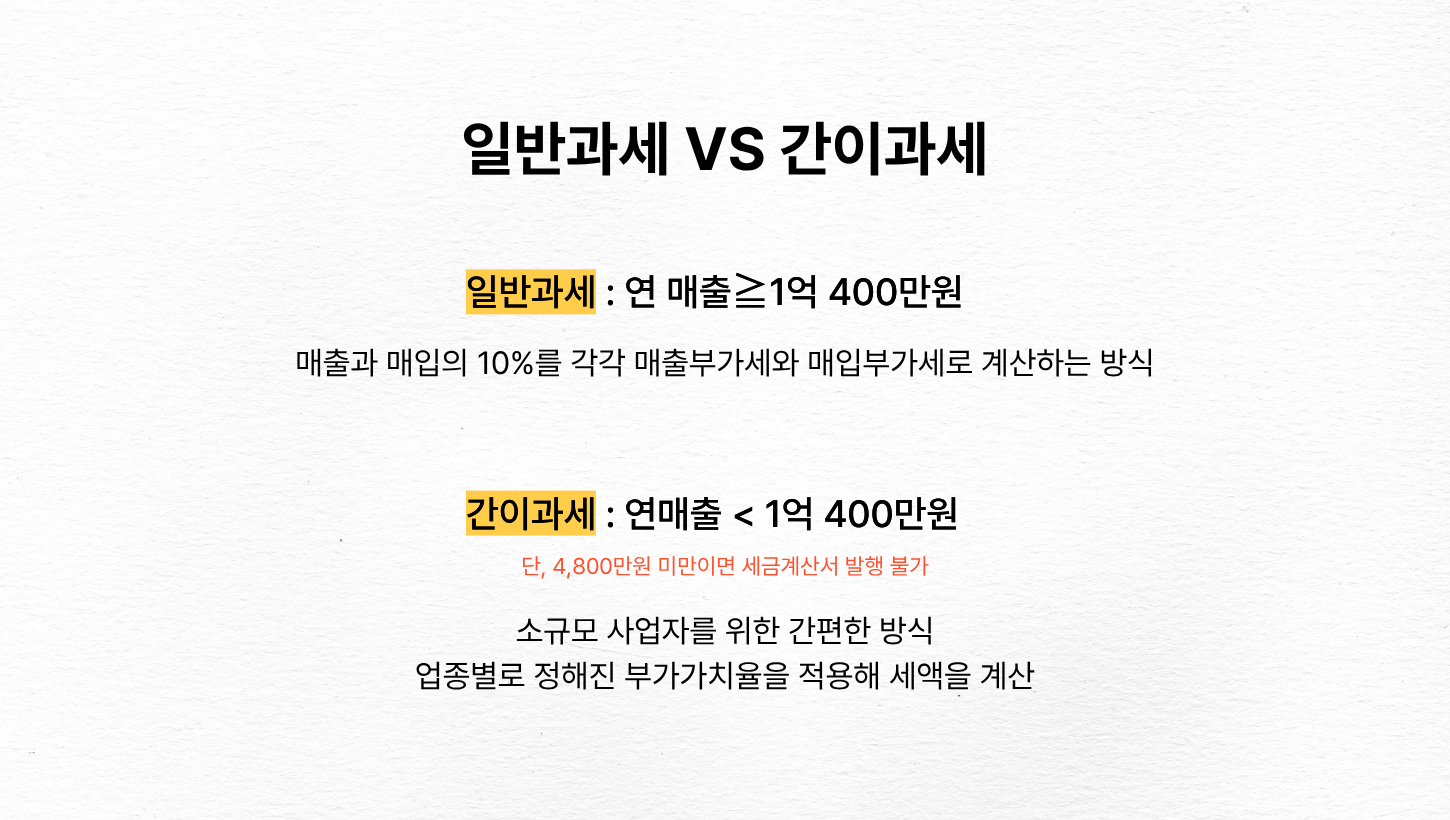
ℹ️ General taxation
This method calculates 10% of sales and 10% of purchases as sales VAT and purchase VAT respectively. In high-spending periods like early startup, general taxation can be advantageous, because you can deduct purchase VAT and receive a refund. If annual revenue reaches 104 million won or more, you're automatically converted to a general taxpayer. One caution: if you hold multiple business registrations and even one becomes general-taxed, all the others are treated as general taxation too.
ℹ️ Simplified taxation
A simpler method for small businesses. It calculates tax by applying an industry-specific value-added rate, with a low rate of 1.5% to 4%. However, you can deduct only 0.5% of your purchase amount, and there's a constraint that if annual revenue is under 48 million won, you can't issue tax invoices. You can think of the prior year's supply value as sales excluding tax-exempt items. On top of that, under 48 million won you're exempt from VAT.
To summarize:
- General taxation: prior-year supply value of 104 million won or more
- Simplified taxation: prior-year supply value under 104 million won
- Can issue tax invoices: 48 million won or more, up to under 104 million won
- Cannot issue tax invoices: under 48 million won
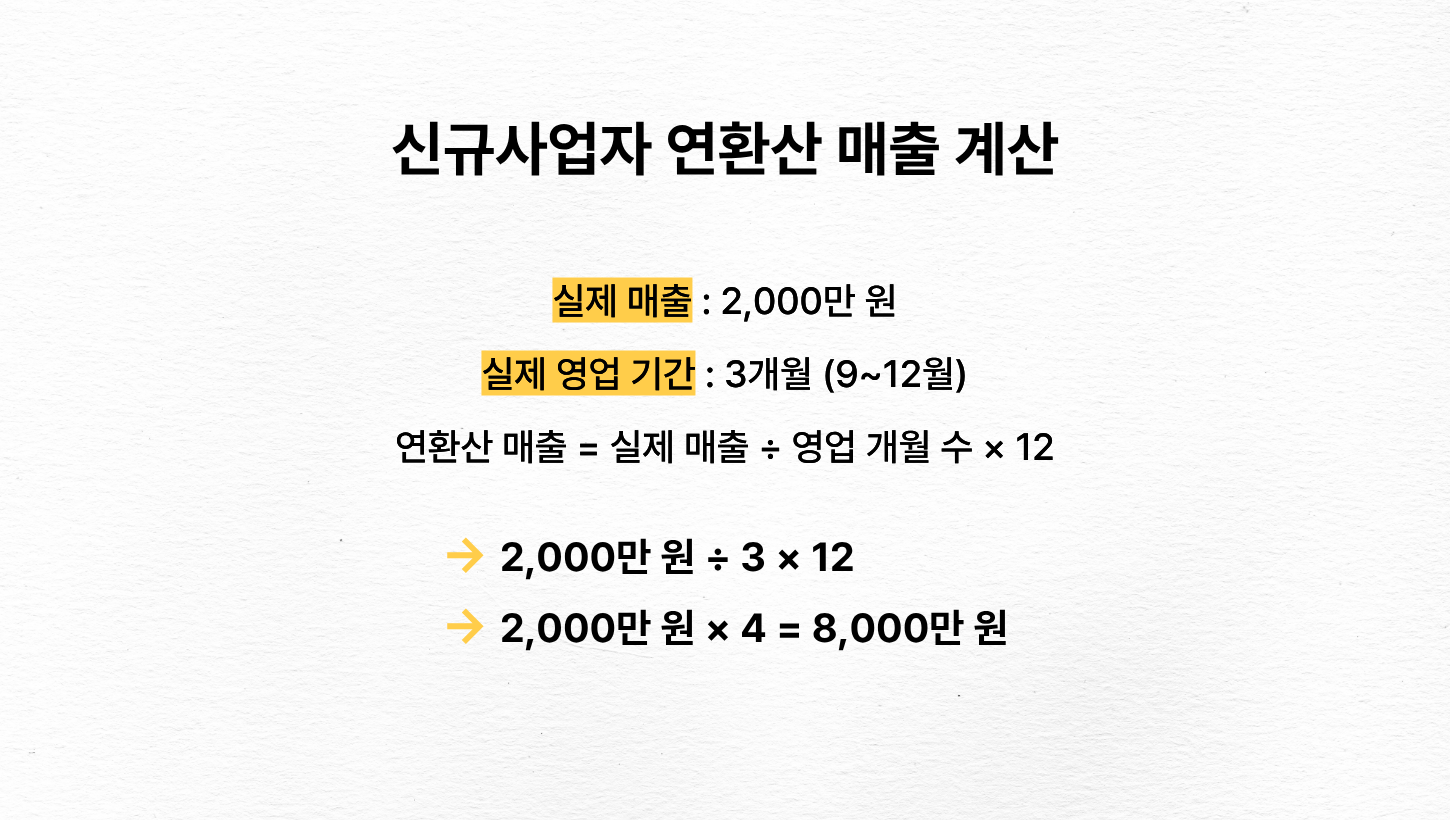
Also, for new businesses, the amount is annualized to 12 months. For example, if you opened in September 2025 and did business for only 3 months, you take sales from September to now × 4 and judge based on that amount.
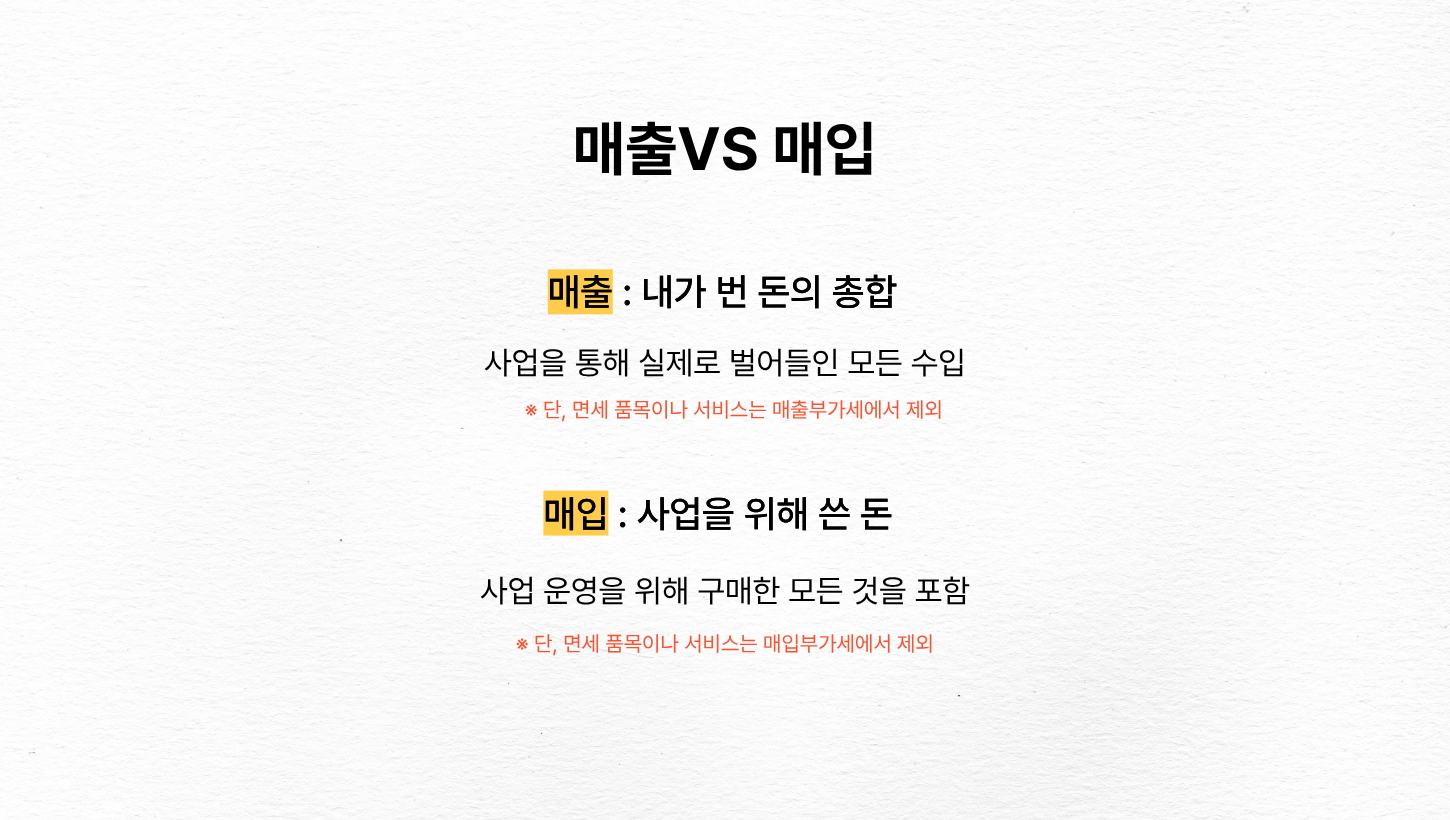
ℹ️ Sales: the total of what you earned
Sales means all income actually earned through your business. If you sold a product, the sales revenue; if you provided a service, the service fee — all of it is included. Simply put, think of it as all the money you received. 10% of this sales amount is usually the sales VAT. Note that tax-exempt items or services are excluded from sales VAT.
ℹ️ Purchases: the money spent for the business
Purchases include everything bought to run the business. From goods to sell, to B2B service fees, SaaS subscriptions, and office supplies — every business-related expense counts. Why do purchases matter? Because VAT is borne by the final consumer, the VAT a business pays when spending is returned by the government. 10% of the purchase amount is treated as purchase VAT, and if purchases exceed sales, you can get the difference refunded.
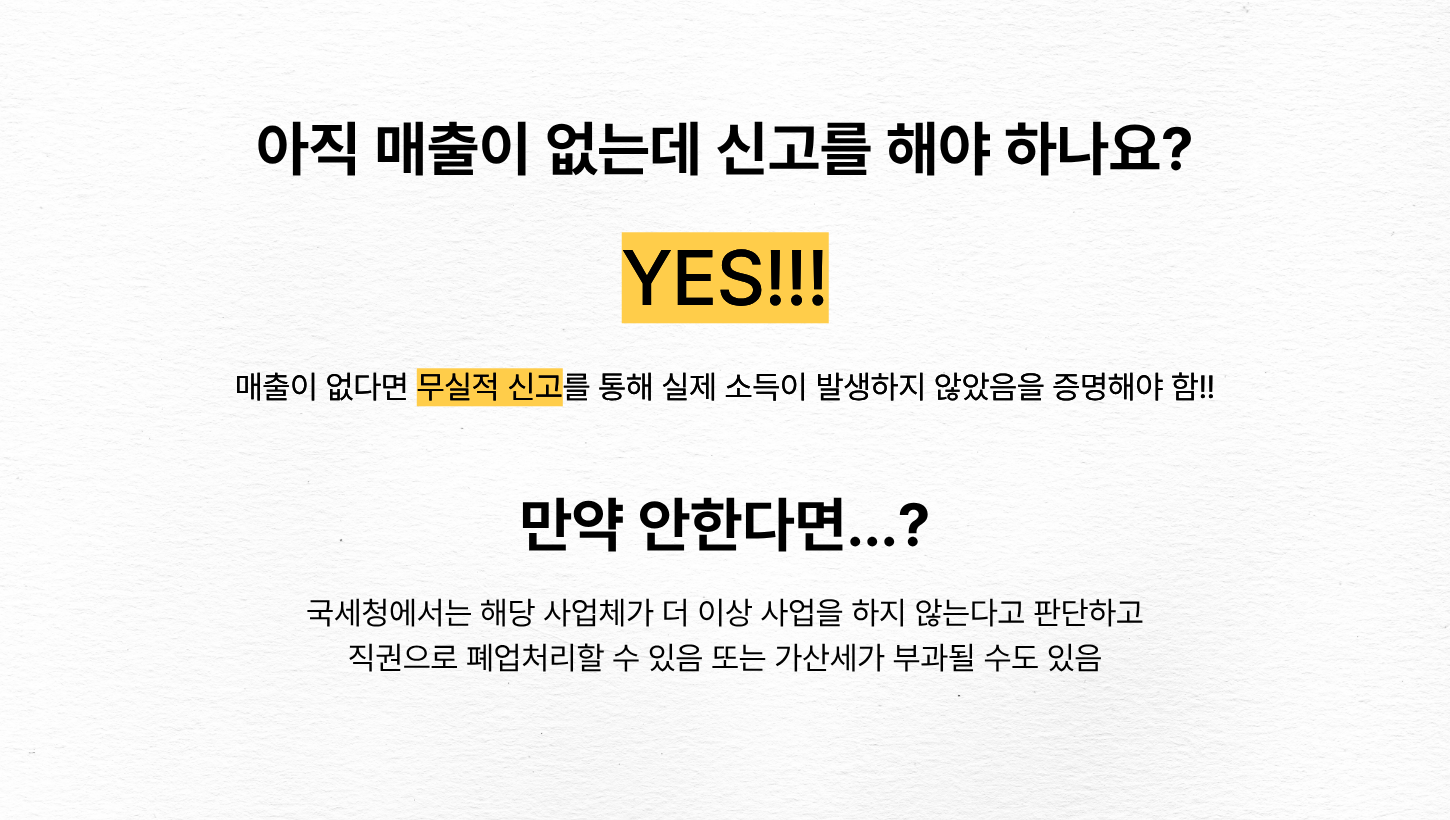
As with sales, remember that tax-exempt items are excluded from purchase VAT. Even with no sales, filing is mandatory! "Do I really have to file if I have no sales?" Many people wonder. The answer is yes. Even with zero sales, you must file VAT.
Through VAT filings, the National Tax Service judges whether a business is operating normally and whether there are any issues. These filings are also used as base data for future corporate tax or comprehensive income tax filings. What happens if you keep not filing? The NTS may conclude the business is no longer operating and close it down on its own authority — and penalties may apply.
So if you have no sales, file a nil return to prove no actual income occurred.
If you want to save on taxes, check out the video below!
✅ Grasp the basics and VAT is entirely manageable
VAT looks complex, but with a firm grasp of the basics, it's entirely manageable. Accurately identify your taxation type, meticulously record sales and purchases, and file without fail even with no sales. Just remembering these three is half the battle!
That's it for our look at VAT. If it still feels hard, why not check out the partner services we've prepared for CoworkCity users?
